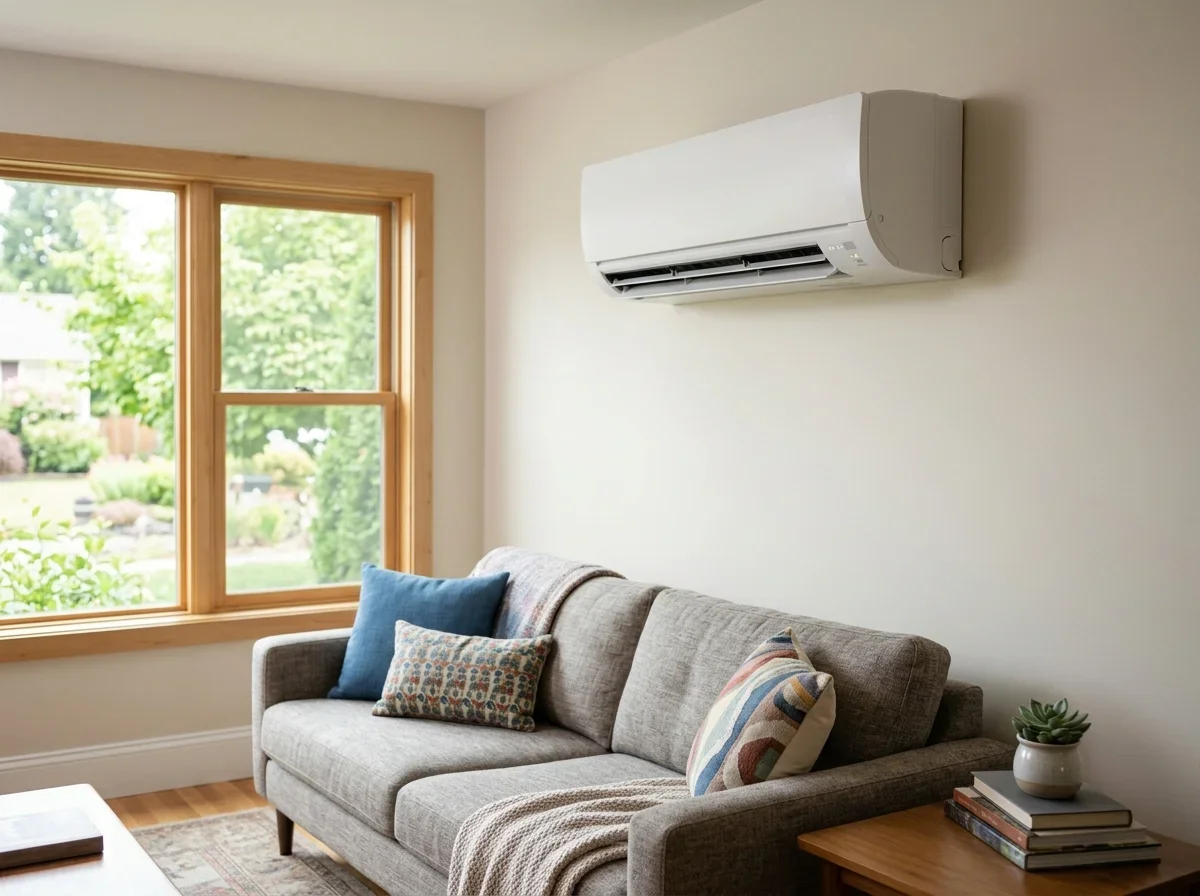
What is the difference between a mini-split and central air?
Central air uses one outdoor unit, an indoor coil and air handler, and a network of ducts that deliver air to every room. A mini-split (ductless) pairs an outdoor unit with one or more indoor heads connected by refrigerant lines. There are no ducts, and each head delivers air directly into its space.[5]
Both can be heat pumps, so "mini-split vs. heat pump" is a bit of a false choice.
If you want that comparison on its own, see Heat Pump vs. Central AC.
Where ducted mini-splits fit
A ducted mini-split is a hybrid. It uses a compact air handler and short duct runs to serve hidden vents, which suits homeowners who want the ductless equipment without wall-mounted heads.
In Phoenix there is a catch. If those ducts end up in a hot attic, you bring back the losses you were trying to escape.
They are worth considering when the air handler and ducts can sit inside conditioned space. For how installs work, see Mini-Split Installation.
Mini-split vs. central air at a glance
| Mini-split (ductless) | Central air (ducted) | |
|---|---|---|
| Best fit | Additions, garages, casitas, homes with poor or no ducts | Whole homes with sound, sealed ducts |
| Efficiency and duct losses | No duct leakage or conduction losses[1] | Ducts can lose 25% to 40% of cooling energy through leakage and heat transfer[2] |
| Upfront cost drivers | Number of heads, electrical work, line-set routing | Ductwork condition, home size, electrical work |
| Zoning | Room-by-room control by default | One thermostat unless zoned |
| Appearance | Visible indoor heads and line sets | Hidden ducts, simple vents |
| Additions and garages | Usually simpler; no duct extension | May overload existing capacity or need long duct runs |
| Permit and license notes | Switching from ducted may change permit scope; confirm with your city | Like-for-like swaps are often simpler; rules vary by city |
Which is more efficient in Phoenix heat?
Mini-splits usually have the edge, mainly because they skip the ducts. Standard duct systems can lose 25% to 40% of the energy they carry through leakage and heat transfer.[2] Another DOE evaluation puts average thermal losses at about 20%.[1]
Price range
Duct energy losses
| Item | Low | High |
|---|---|---|
| Standard duct systems | 25 percent | 40 percent |
| Another DOE evaluation (average) | 20 percent | 20 percent |
Phoenix makes that worse. Most homes here were built around 1985 with ducts in an unconditioned attic, so conditioned air travels through the hottest part of the house. The city logged 113 straight days at 100°F or above in 2024, which means those losses happen exactly when the system runs hardest.
Equipment matters too, so compare SEER2 ratings on the actual units you're quoted.
Will a mini-split raise my electric bill?
It depends on what it replaces. If a mini-split takes over part of a central system's workload, such as cooling bedrooms at night instead of the whole house, your bill can drop.
If it adds a new cooled space like a garage or addition, you are adding load, so the bill goes up somewhat. Check current rate details with SRP or APS before you decide.
How do upfront costs compare?
Cost depends on the job, not just the equipment type. The main drivers are how many indoor heads you need, the condition of your existing ducts, any electrical work, and the size of the home.
A multi-zone mini-split can cost more upfront than a central replacement when the ducts are in good shape.
The math flips when ducts are failing, undersized, or absent. If your ducts are the question, read Attic Duct Replacement in Phoenix before you collect quotes.
For Phoenix pricing, see Is a Mini-Split Worth It? What Installation Costs in Phoenix.
What is the "$5,000 rule"?
It's a repair-vs-replace rule of thumb: multiply the system's age by the estimated repair cost, and if the result is high enough, replacement usually makes more sense.
Our guide on repairing or replacing your AC in Phoenix walks through the decision.
Which works better for whole homes, additions and garages?
A whole house with sound ducts is usually simpler and tidier with central air.
Additions, converted garages, casitas and sunrooms are where ductless shines. Extending ducts into them can mean opening ceilings and crossing the attic. Phoenix homes are slab-on-grade with no basement or crawlspace, so there is rarely an easy path for new ducts.
Side by side
Central versus ductless
Central
- Ducts sealed, insulated and in good shape
- Many bedrooms and living areas
- No visible indoor heads
Ductless
- Ducts failing, undersized or missing
- Addition, casita or garage
- Rooms used on different schedules
Choose central if:
- Your ducts are sealed, insulated and in good shape
- You have many bedrooms and living areas that need even temperatures
- You dislike visible indoor heads
Choose ductless if:
- Your ducts are failing, undersized or missing
- You are conditioning an addition, casita or garage
- Rooms are used on different schedules
A hybrid also works: keep your central system and add a single head to a problem room.
Cooling a garage or addition
A garage in a Phoenix summer is a heavy load. Insulate the ceiling, walls and door first.
Have your contractor run a Manual J load calculation instead of relying on a rule of thumb.
Pro tip
Insulate the ceiling, walls and door before sizing a unit for a garage, then have the contractor run a Manual J load calculation so the system isn't oversized.
How do they compare on looks, noise and comfort?
Central air wins on looks. Vents are discreet, and the look is uniform throughout the house.
Indoor mini-split heads are visible on walls, which is the most common objection.
Mini-splits let you set each room separately, which is great for bedrooms at night. Central air with one thermostat tends to feel more uniform across the whole house.
Key takeaways
- Mini-splits skip the 25% to 40% duct losses common in standard duct systems
- Central air suits a whole house with sound, sealed ducts
- Ductless suits additions, garages and homes with failing ducts
- Mini-split heads are visible, but they give room-by-room control
Indoor noise is generally low with mini-splits, but it varies by model.
What license and permit rules apply in Phoenix-area cities?
Hire a contractor with an active ROC license in an R-39, R-39R or CR-39 class that covers your work.[3] Confirm it on the ROC Contractor Search at roc.az.gov/before-hire.
Also ask which technicians hold EPA Section 608 certification for refrigerant handling. For more, see Arizona ROC HVAC License.
Permit rules vary by city:
- Phoenix: no permit for a like-for-like replacement unless size, capacity or location increases
- Scottsdale: a Minimum Mechanical Permit is required even for like-for-like
- Mesa: none if the new unit uses the same or less electricity, though changing electrical connections needs a permit
- Maricopa County (unincorporated): like-for-like permits are web-issued, and roof-mounted units go to technical review
Switching from ducted to ductless likely changes the scope of work, so confirm the permit with your city before signing.
For the broader picture, see Does Replacing Your AC Need a Permit in Phoenix Metro?
Frequently asked questions
Is a mini-split better than central air in Phoenix?
Not always. Central air wins for a whole house with sound ducts. A mini-split wins for additions, garages and homes with failing attic ducts.
Are ducted mini-splits worth it?
They can be, if you want hidden vents without full ductwork and can route the air handler and ducts through conditioned space. In a hot attic, they inherit the duct-loss problem.
Can a mini-split cool a garage or addition?
Yes, if the space is insulated and sized from a load calculation.
Will a mini-split make my electric bill go up?
If it adds cooling, yes. If it replaces some of your central system's workload, it can lower the bill.
How much does a mini-split cost for a 2,000 sq ft house?
It depends on the number of heads, electrical work and your ducts. See the mini-split cost guide for Phoenix pricing.
What is the $5,000 rule for HVAC systems?
A repair-vs-replace rule of thumb that weighs repair cost against system age. See Repair or Replace Your AC? for how to apply it.
Questions
- U.S. Department of Energy, Building America. "Ductless Mini-Split Heat Pump Comfort Evaluation." https://www1.eere.energy.gov/buildings/publications/pdfs/building_america/ductless_minisplit_hp.pdf. Accessed October 16, 2026.
- U.S. Department of Energy, Building America. "Improving the Efficiency of Your Duct System." https://www1.eere.energy.gov/buildings/publications/pdfs/building_america/27630.pdf. Accessed October 16, 2026.
- Arizona Registrar of Contractors. "License Classifications." https://roc.az.gov/license-classifications. Accessed October 16, 2026.
- Arizona Registrar of Contractors. "License Classification Requirements." https://roc.az.gov/sites/default/files/2022-07/License%20Classification%20Requirements_6.8.20_0.pdf. Accessed October 16, 2026.
- U.S. Department of Energy, Building Science Education. "Introduction to Heat Pumps Level 2." https://bsesc.energy.gov/sites/default/files/2024-08/Introduction%20to%20Heat%20Pumps%20Level%202%20-%20Lecture%20Notes%20%26%20Problem%20Sets.docx. Accessed October 16, 2026.
- Arizona Registrar of Contractors. "Applying for a License." https://roc.az.gov/applying-for-a-license. Accessed October 16, 2026.