What does Phoenix attic heat do to flex duct?
Phoenix logged 113 consecutive days at or above 100°F in 2024, which broke the 76-day record set in 1993. Your AC runs hard through nearly all of that stretch.
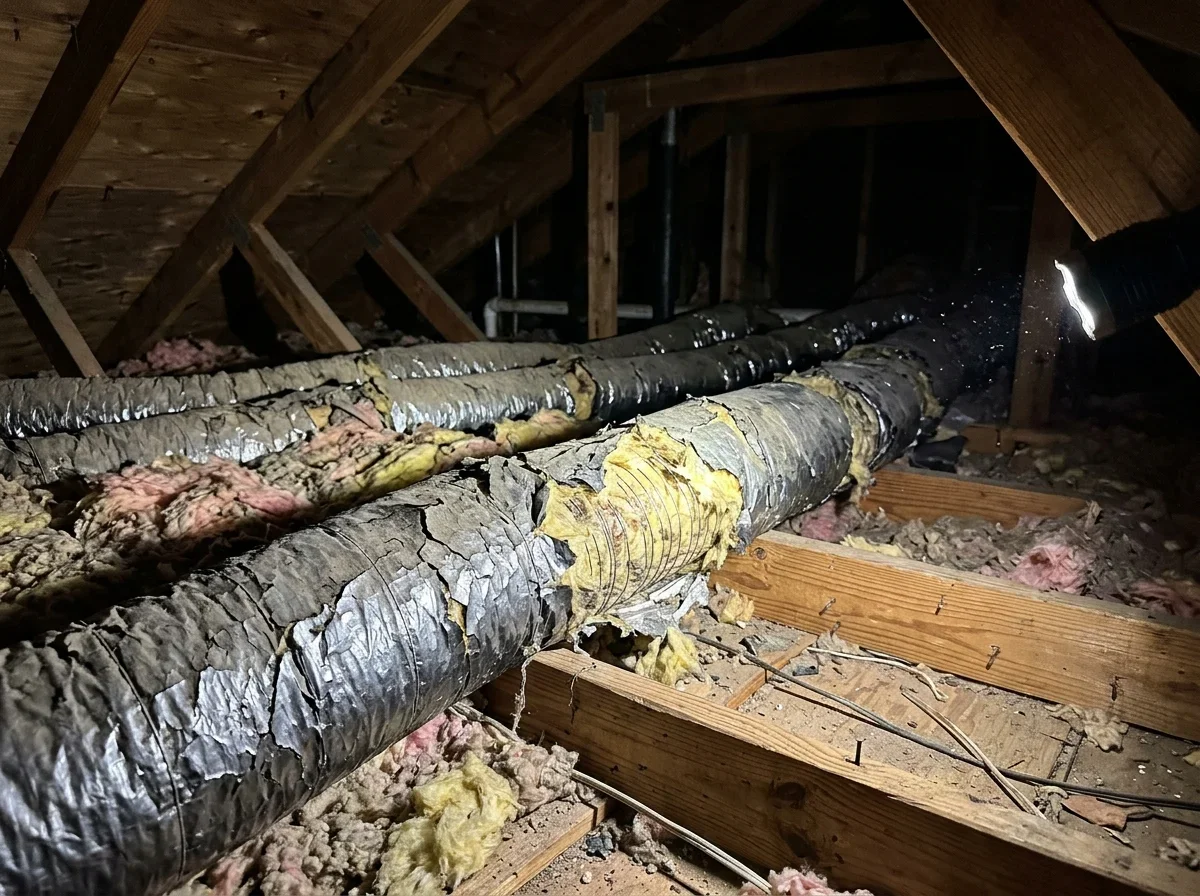
Most attic runs are flex duct, built in three layers: an inner liner that carries the air, a layer of insulation, and an outer jacket. Over years of heat, the jacket can crack, the liner can stiffen, and connections can loosen.
How the parts connect
The three layers of flex duct
Inner liner
Carries the air
Insulation layer
Sits around the liner
Outer jacket
Can crack in attic heat
Sagging and compression make it worse. That's why DOE guidance calls for flex ducts in unconditioned spaces to be insulated, supported against sagging, and connected with proper collars and draw bands.[2]
Placement matters too. ENERGY STAR notes that ducts perform better in conditioned space than in an excessively hot attic.[4]
Metal, rigid and hybrid systems age differently than flex. Our ductwork repair, sealing and replacement page covers the options.
Signs your attic ducts need more than a repair
Start with what you can feel at home. Weak airflow in far rooms, a bedroom that never cools, dust streaking around registers and supply air that feels warm are all common.
Then look from the attic hatch, with a flashlight and without stepping off the joists. You're checking for:
- Cracked, brittle or torn outer jackets
- Runs that sag, kink or are crushed under stored items
- Connections that have pulled loose from the collar
- Wet, stained or compressed insulation
- Disconnected branches or old ducts that don't match the layout
A visual check only goes so far. The DOE guidance calls for inspecting the whole system and testing leakage before and after sealing.[5] A measured duct-leakage test (often called a duct blaster test) tells you whether you have a few accessible leaks or widespread failure.
If the symptoms could be equipment-related, check why your AC is blowing warm air first. If dirt is your only concern, is air duct cleaning worth it covers that question.
When is duct sealing enough, and when should you replace?
Sealing works when the runs themselves are intact. ENERGY STAR recommends sealing accessible attic ducts with mastic or metal tape and insulating them. It steers you away from standard duct tape because it doesn't last.[1]
Side by side
Sealing versus replacement
Seal
- Runs are intact
- Leaks are at boots, joints and the plenum
Replace
- Jackets are cracked or liners collapsed
- Runs are undersized or badly routed
Replacement makes sense when sealing would just be patching a failing product. Use this as a checklist:
| Outcome | What you see |
|---|---|
| Seal | Runs are intact; leaks are at boots, joints and the plenum |
| Partial replacement | Specific runs have cracked jackets, crushed or sagging sections, or wet insulation |
| Full replacement | Jackets are cracked throughout, liners have collapsed, or runs are undersized or badly routed |
Sizing deserves its own question. ACCA Manual D sets out the calculations for sizing residential duct systems.[3] ENERGY STAR ties duct sizing to Manual J and Manual D as well.[4]
New ducts copied from an undersized layout will repeat the same hot rooms. Ask whether the quote includes a design check.
Pro tip
Ask whether the quote includes a design check, so new ducts aren't copied from an undersized layout.
Here is how the three options compare:
| Option | Best when | What the work involves | Main cost drivers | Limits |
|---|---|---|---|---|
| Duct sealing | Runs are sound; leaks are at joints, boots and plenum | Mastic at connections, boots and plenum; added insulation where it's thin; leakage testing | Number of leaks, attic access, amount of insulation work | Won't fix cracked jackets, collapsed liners or poor layout |
| Partial replacement | Only certain runs are damaged | Removing and replacing the worst runs, reconnecting registers, sealing and reinsulating | Number and length of runs, access, disposal | Old sections that remain can still fail |
| Full replacement | Damage is widespread or the layout is wrong | Removing old duct, installing new runs, new boots, supports and insulation, testing | Square footage, runs and registers, material, insulation R-value, plenum and returns | Highest upfront cost; doesn't fix an undersized system on its own |
How much does attic duct replacement cost in Phoenix?
Quotes swing widely because the work does. The main factors are your home's square footage, the number of runs and registers, duct material, attic access and clearance, insulation level, removal of old duct, and whether the plenum or return ducts are included.
Many Phoenix-area HVAC company websites don't publish duct sealing or full duct replacement prices, so get written quotes from local contractors for either job. What they do publish is repair and service-call pricing. Most list a diagnostic fee of $89 to $99, and some waive or credit it if you approve the repair.
Scope is the biggest reason bids differ. "Duct sealing" might mean one connection, every accessible joint, or a rebuilt section.
Key takeaways
- Many Phoenix-area companies don't publish duct sealing or full replacement prices
- Most list a diagnostic fee of $89 to $99
- Scope is the biggest reason bids differ
- Get itemized written quotes from at least three contractors
Compare at least three itemized written bids. Check:
- Linear feet of duct and number of branches
- Trunk and plenum work
- Insulation rating
- Supports, registers and boots
- Removal and disposal of old duct
- Attic cleanup
- Testing, warranty and permit fees
For utility help, see our guides on SRP AC rebates and APS rebates.
Permits, licensing and hiring a duct contractor in the Valley
Permits differ by city
Permit rules are set city by city, so check with your local permit desk about whether duct-only work needs a permit. Ask your contractor which rule applies and who pulls the permit.
| City | Rule for equipment replacement |
|---|---|
| Phoenix | No permit for repair or replacement that doesn't increase size, capacity or location |
| Scottsdale | Minimum Mechanical Permit for like-for-like unit replacement; Mechanical Permit to install, alter or repair HVAC equipment |
| Mesa | Permit applicants must provide an ROC license number or exemption basis |
Our guide on AC replacement permits in the Phoenix area goes deeper.
Verify the contractor before you sign
Arizona HVAC contractors are licensed by the Registrar of Contractors (ROC), with classes including R-39, R-39R and CR-39. Check the record through the ROC's before-you-hire page. Our guide to the Arizona ROC HVAC license explains the classes.
- Match the license number and the business name to the company on your contract.
- Check license status and complaint history.
- Ask for proof of insurance and call the insurer. The ROC says it requires workers' compensation, but not liability coverage.
- Get a written contract with the license number and start and completion dates.
- Make checks payable to the company named, and don't let payments run ahead of the work.
For credentials such as NATE, EPA 608 and NADCA, see what HVAC credentials mean. If you want a fuller list of questions, use our pre-hire checklist.
Frequently asked questions
How much does it cost to replace AC ducts in an attic?
It depends on square footage, the number of runs, material, access and whether the plenum is included. Phoenix-area company sites don't publish full-replacement prices, so get itemized written quotes.
How do you insulate attic HVAC ducts?
How many types of ducts are used in HVAC?
Residential systems commonly use flexible, rigid sheet metal and hybrid setups. Our ductwork service page explains how they compare.
Can you paint exposed ductwork?
Paint won't seal leaks or add insulation, so it won't fix an attic duct problem.
Can I replace just the ductwork without replacing the AC?
Yes. Ducts and equipment are separate parts of the system. But new ducts won't fix undersized equipment, so ask for a design check.
Is metal or flex duct better for a Phoenix attic?
Either can work when it is sized, supported, sealed and insulated correctly. Flex needs careful support, with ENERGY STAR recommending supports at intervals no greater than 5 feet and avoiding excessive coils and loops.[6]
Questions
- ENERGY STAR. "Duct Sealing." https://www.energystar.gov/saveathome/heating-cooling/duct-sealing. Accessed October 16, 2026.
- U.S. Department of Energy Building America Solution Center, Pacific Northwest National Laboratory. "Sealed and Insulated Flex Ducts." https://basc.pnnl.gov/resource-guides/sealed-and-insulated-flex-ducts. Accessed October 16, 2026.
- Air Conditioning Contractors of America. "Manual D® Residential Duct Design." https://www.acca.org/standards/technical-manuals/manual-d. Accessed October 16, 2026.
- ENERGY STAR. "Duct Systems." https://www.energystar.gov/ia/new_homes/features/DuctSystems_062906.pdf. Accessed October 16, 2026.
- U.S. Department of Energy. "Duct Sealing and Insulation." https://www.osti.gov/servlets/purl/1638130. Accessed October 16, 2026.
- ENERGY STAR. "ENERGY STAR HVAC Quality Installation Guidebook." https://www.energystar.gov/ia/partners/bldrs_lenders_raters/downloads/ENERGY_STAR_V3_HVAC_Quality_Installation_Guidebook.pdf. Accessed October 16, 2026.