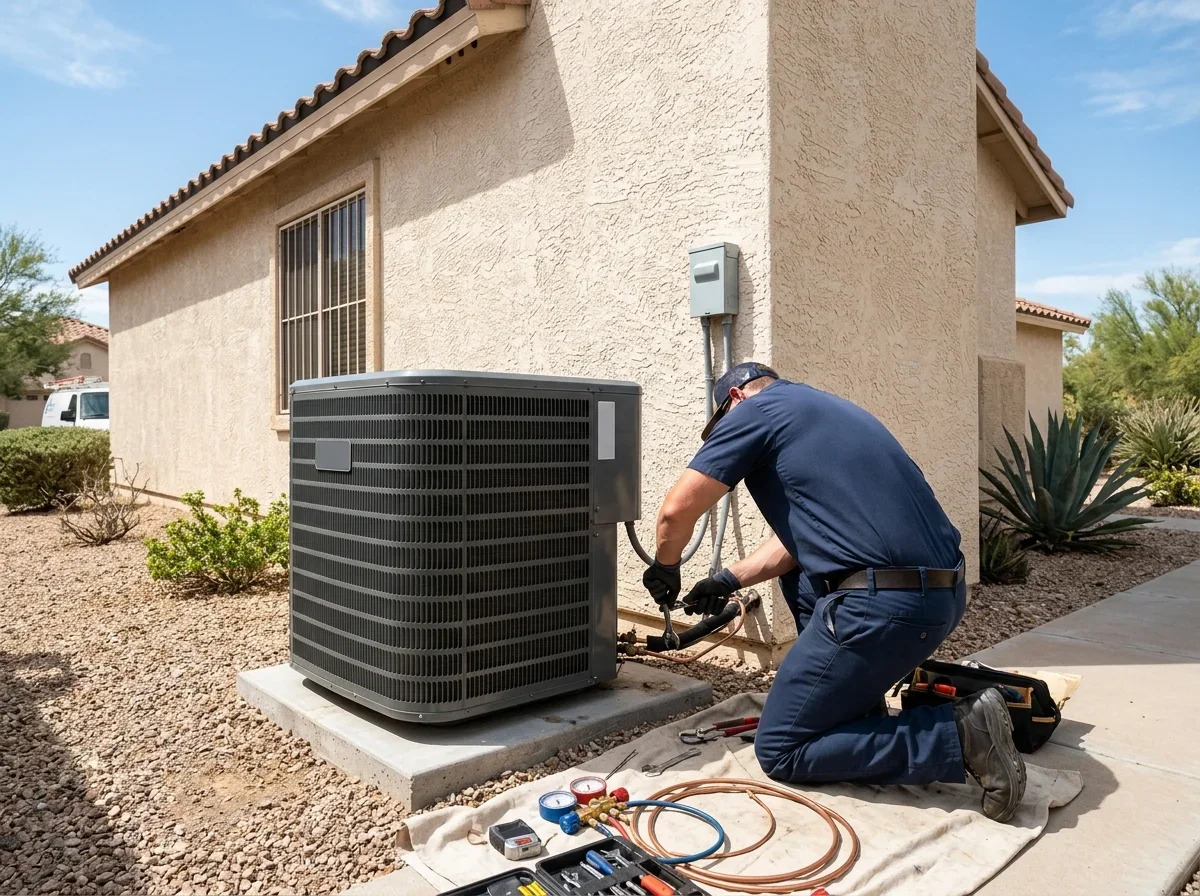
How do I decide whether to repair or replace my AC?
Run through five checks, in this order:
- System age. Find the install year on the data plate.
- Repair quote. Get it in writing, with the failed part named.
- Refrigerant type. The data plate lists it.
- Repairs in the last two years. Count the major ones.
- Energy bills and comfort. Note whether bills are climbing or rooms are uneven.
A young system with one failed part and a stable refrigerant type leans repair. An older system with a pricey fix, an outdated refrigerant, or a second major failure leans replacement. Mixed results mean you need real numbers from both options.
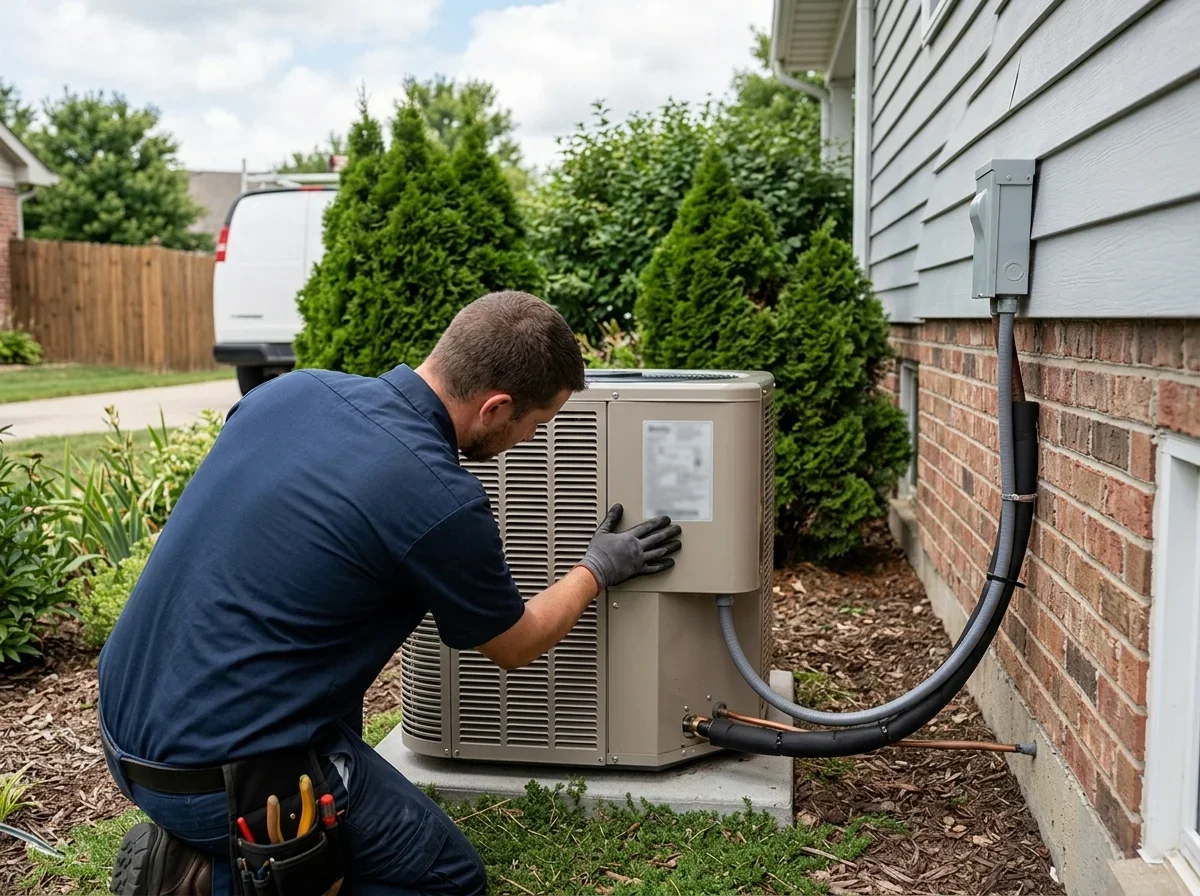
Phoenix tilts the math. In 2024 the city logged 143 days at or above 100°F[1], so a Phoenix system can rack up runtime that calendar age doesn't show.
For what a fix runs, see the AC repair cost guide. For what a new system costs, see the AC replacement cost guide.
What are the $5,000 rule and the 50% rule, and do they work in Phoenix?
Both are rules of thumb, not guarantees.
The $5,000 rule multiplies the unit's age by the repair quote. If the product lands above $5,000, replacing starts to look smarter. The 50% rule says to replace when the repair costs more than half the price of a new system.
Two cases
The two rules of thumb
Case A: $5,000 rule
- Unit age times repair quote
- Over $5,000 leans replace
Case B: 50% rule
- Repair compared with a new system
- More than half the price leans replace
The rules fall short in four ways:
- They ignore refrigerant. A cheap-looking fix on an older system can become a leak chase.
- The 50% rule needs a replacement quote, and most people don't have one yet. Get both in writing.
- Neither counts repeat failures. Two or three major repairs in about two years say more than any formula.
- Neither counts Phoenix runtime. A unit with an attic air handler and a rooftop condenser has likely worked harder than the same unit in a mild climate.
How long does an AC unit last in Phoenix?
Lifespan depends on the equipment, the install quality, and the climate. Your technician can estimate remaining life for your specific unit. Ask for that estimate rather than accepting "it's old."
Desert systems may fall short of generic ranges. The cooling season runs for months, attic and rooftop heat stresses components, and dust loads up coils and filters.
Maintenance moves the needle too. A system with regular AC tune-ups and clean filters (see how often to change filters in Phoenix) usually gives you more warning before a failure.
Pin down the real age first. The data plate lists a manufacture date, and permit or purchase records show the install year.
Does refrigerant type or a repeat failure change the answer?
Yes to both.
Older refrigerant
EPA does not require you to replace existing R-22 equipment, and existing systems can still be serviced[2]. But new R-22 can no longer be manufactured or imported, so servicing relies on recycled, reclaimed, or previously produced supply[3]. That can affect availability and cost when the problem is a leak.
One Phoenix company's site lists refrigerant-related work at $400–$1,200+ (Phoenix-area HVAC companies' own websites, checked October 2026).
Technicians must recover refrigerant during service, and venting it is illegal[4]. Avoid anything marketed as "R-22a" or "22a." It is highly flammable and not approved for residential AC systems[6].
Pro tip
If the unit uses R-22 and the fix involves a leak, ask for both a repair quote and a replacement quote in writing before deciding.
For leak work, see refrigerant recharge and leak repair.
Repeat failures
A second or third major repair in a short window signals a system that is failing. EPA allows repairs to existing R-22 equipment, including failed major components, when parts are available[5], but "allowed" is not "wise."
When repair still wins
Repair makes sense on a younger system with one failed part, especially under warranty (check your manufacturer's terms).
One Phoenix company's site lists capacitor or contactor repair at $200–$600, and major component repair at $1,000–$3,000+. See the guides to capacitor and compressor costs, or the compressor and capacitor service.
Price range
Listed repair cost by job
A bar with a break runs past the scale; its full range is written above it.
| Item | Low | High |
|---|---|---|
| Capacitor or contactor repair | $200 | $600 |
| Major component repair | $1,000 | $3,000 |
Repair or replace: side-by-side comparison
| Factor | Repair usually makes sense when | Replacement usually makes sense when |
|---|---|---|
| System age | The unit is well within its expected life | The unit is near or past its expected life, especially after heavy desert runtime |
| Refrigerant type | The system uses current refrigerant | It uses phased-out R-22 and the fix involves a leak |
| Repair history | This is the first or only repair in two years | You've had two or more major repairs in a short span |
| Type of failure | A single inexpensive part, such as a capacitor or contactor | Compressor failure, a major leak, or severe coil damage |
| Energy bills and comfort | Bills are stable and rooms cool evenly | Bills keep climbing or the house won't hold temperature |
| Permit and paperwork | Phoenix: none for like-for-like repair | Replacement may need a permit, depending on city and scope |
What should I check before approving either job?
Work through this list before you sign anything:
- Verify the license. Look up the contractor in the ROC Contractor Search via roc.az.gov/before-hire. HVAC work for a home falls under R-39, R-39R, or CR-39. Our guide to verifying an HVAC license walks through it.
- Get a written contract with the license number. Licensed does not mean insured, so ask for certificates.
- Request both quotes. Ask for a written repair quote and a written replacement quote, so the 50% test uses real numbers. A diagnostic fee is typically $89 to $99 at most Phoenix-area HVAC companies' own websites (checked October 2026).
- Ask what the replacement includes. Removal, crane or roof access, ductwork, electrical changes, thermostat, pad, drain work, startup testing, and warranty should all appear in the quote.
- Ask who pulls the permit, and under whose license. Phoenix needs none unless size, capacity, or location changes. Scottsdale requires a Minimum Mechanical Permit. Mesa needs none if electricity use stays the same or lower. Our permit guide covers more.
- Know your cancellation right. A sale made at your home carries a three-business-day cancellation right under A.R.S. 44-5004.
For replacement quotes, start at AC replacement and installation.
Checklist
Before you approve a job
0 of 6 ticked
Tick them off as you go. Nothing is saved or sent.
Frequently asked questions
What is the $5,000 rule for AC?
Multiply the unit's age by the repair quote. If the result is over $5,000, replacement usually looks smarter.
How long does an AC unit last?
It depends on equipment, installation, and upkeep. Desert runtime, attic heat, and dust can shorten it, so ask your technician for an expected remaining life on your unit.
How much does it cost to replace an AC in a 2,000 sq ft house?
Cost depends on tonnage, efficiency, equipment location, ductwork, and electrical scope. See the replacement cost guide and the tonnage and pricing guide, then get itemized written quotes.
What AC brands should I stay away from?
Reliability depends heavily on installation quality. Check the installer's ROC license, ask about manufacturer dealer programs, and confirm a program's criteria on the manufacturer's own site.
Is it worth repairing an older AC?
Sometimes, if the fix is small and the system has been trouble-free. A major repair, a refrigerant leak, or repeat failures point toward replacement.
Do I need a permit to replace my AC in Phoenix?
Phoenix requires none for a like-for-like swap unless size, capacity, or location changes. Other cities differ, so confirm with your city's permit desk and ask your contractor who handles it.
Questions
- National Weather Service, Phoenix. "2024 Climate Year in Review for Phoenix, Yuma, and El Centro." https://www.weather.gov/psr/yearinreview2024. Accessed October 16, 2026.
- U.S. Environmental Protection Agency. "Homeowners and Consumers: Frequently Asked Questions." https://www.epa.gov/ods-phaseout/homeowners-and-consumers-frequently-asked-questions. Accessed October 16, 2026.
- U.S. Environmental Protection Agency. "Servicing Existing Units." https://www.epa.gov/ods-phaseout/purchasing-and-repairing-home-air-conditioners-or-heat-pumps. Accessed October 16, 2026.
- U.S. Environmental Protection Agency. "Residential Air Conditioning and the Phaseout of HCFC-22." https://www.epa.gov/sites/default/files/2020-03/documents/residential_air_conditioning_and_the_phaseout_of_hcfc-22_what_you_need_to_know_final_508.pdf. Accessed October 16, 2026.
- U.S. Environmental Protection Agency. "Technicians and Contractors: Frequent Questions." https://www.epa.gov/ods-phaseout/technicians-and-contractors-frequent-questions. Accessed October 16, 2026.
- U.S. Environmental Protection Agency. "Stationary Refrigeration Resources for Homeowners." https://www.epa.gov/section608/stationary-refrigeration-resources-homeowners. Accessed October 16, 2026.