Does an HVAC contractor need a license in Arizona?
Yes, in almost every case. The Arizona Registrar of Contractors (ROC) licenses HVAC contractors, while cities and counties issue permits. The license class must match the work in your contract.
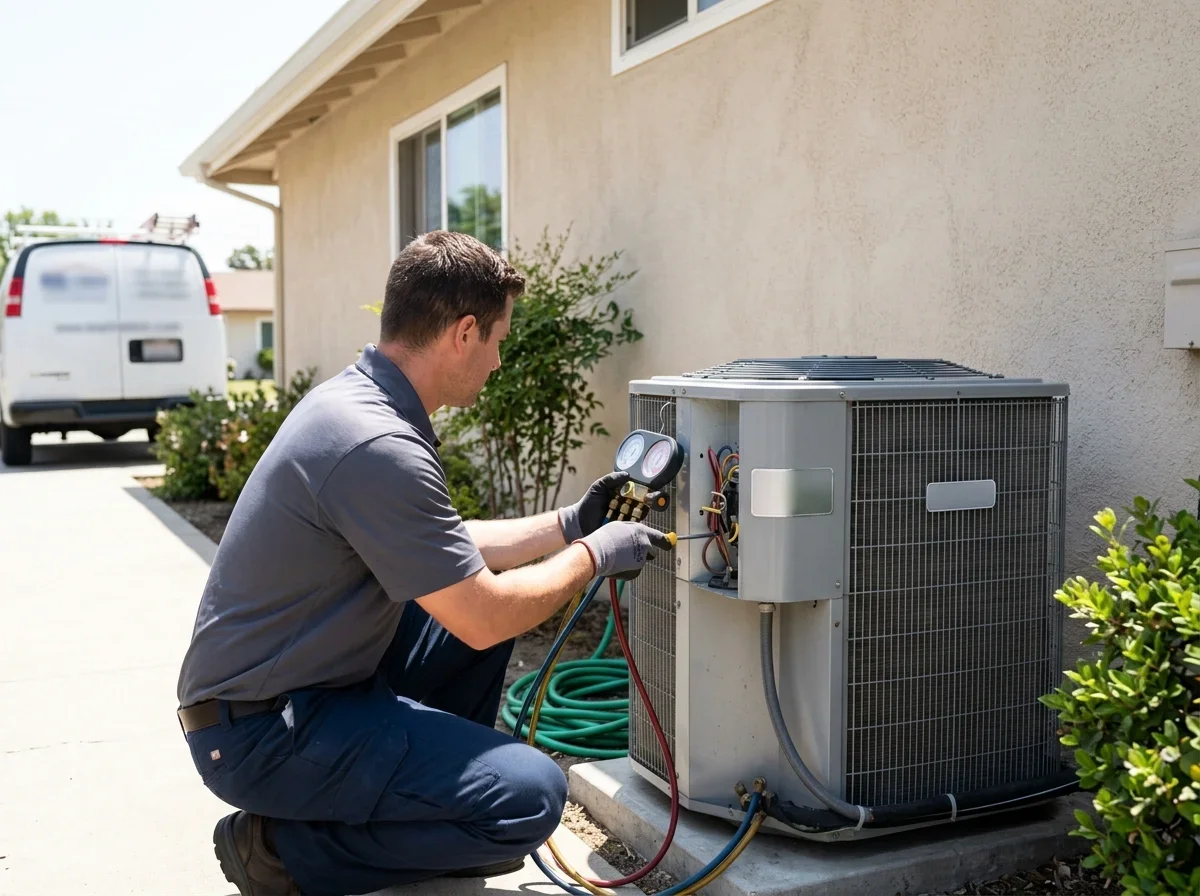
Any business that contracts to repair or improve a structure, or to do part of the work, must hold an ROC license, with narrow exemptions. The best known is the handyman exemption under A.R.S. 32-1121. It applies only if the whole job, materials included, is under $1,000, is casual or minor, needs no local permit, is not split off from a larger job, and does not connect to a gas or fuel supply.
A furnace swap touches gas, and a condenser replacement often triggers a permit, so neither is handyman work. See what these jobs involve on our AC repair and AC replacement and installation pages.
EPA Section 608 is a federal certification for technicians who maintain, service, repair or dispose of equipment that could release refrigerants.[2] It is not a state contractor license, and it does not replace the company's ROC license. Our guide to NATE, EPA 608 and NADCA credentials covers the difference in more detail.
What do the ROC HVAC license classes mean?
The ROC classification list shows C-39, C-58, R-39, R-39R, CR-39 and CR-58.[1] For a homeowner, the first letters tell you the market: R is residential, C is commercial, and CR is dual.
| Class | Residential or commercial | What it covers | Homeowner note |
|---|---|---|---|
| R-39 | Residential | Air conditioning and refrigeration, including solar | The standard residential HVAC class |
| R-39R | Residential | Warm air heating, evaporative cooling and ventilating subclassifications | Closed to new applicants; existing holders may still appear |
| CR-39 | Dual | Scopes of commercial C-39 and residential R-39R | Fits a contractor working in both markets |
| C-39 | Commercial | Air conditioning and refrigeration | Built for commercial buildings |
| C-58 | Commercial | Comfort heating, ventilating and evaporative cooling | Commercial heating and cooling scope |
R-39 residential
R-39 is Air Conditioning and Refrigeration, Including Solar. It covers installing and repairing comfort air conditioning, evaporative cooling, ventilating and heating.[1] It may include adding a new circuit to an existing panel, but a new service panel or sub-panel is excluded.
On your quote: this is the class you most expect to see for a house.
R-39R and why it no longer takes new applications
The ROC states that no new applications or licenses will be issued for the listed R-39R subclassifications, while existing records may still show them.[1] Evaporative cooling is one of them, which matters if your home still has a swamp cooler.
On your quote: confirm the record is active and the scope matches the job.
CR-39 dual license
CR-39 is the dual classification. It covers the scopes of commercial C-39 and residential R-39R.[1] A contractor holding it is licensed for both markets.
On your quote: CR-39 is fine for a home, though you still confirm the scope fits your work.
C-39 and C-58 commercial
C-39 is commercial air conditioning and refrigeration. C-58 is commercial comfort heating, ventilating and evaporative cooling.[1] CR-58 also appears on the list, so check the ROC page for its exact meaning.
On your quote: a commercial-only class on a home job is a reason to ask questions before signing.
Which license class should my HVAC job require?
HVAC work calls for an R-39, R-39R or CR-39 type license, and the class should cover the work in your written contract. Replacing a condenser or air handler fits that rule. So do mini-split installation, heat pump work and ductwork.
Decide
Which license class fits a home job
Is the quoted contractor's class R-39, R-39R or CR-39?
If Yes
then: Confirm the record is active and the scope covers your work
If No, commercial only (C-39 or C-58)
then: Ask questions before signing
R-39 allows a new circuit on an existing panel but excludes a new service panel or sub-panel.[1] Summer load pushes many older Phoenix-area homes toward panel upgrades, so ask who does that work and under which license.
What does an Arizona HVAC license not guarantee?
A license is a regulatory starting point, not a quality guarantee. It does not prove careful installation, honest estimating or a skilled crew.
Insurance and bonds
The ROC requires workers' compensation but no other insurance for licensure, so "licensed" does not mean "liability insured." Ask for proof of coverage, ideally a certificate sent straight from the insurer.
A license also needs a surety bond or cash deposit in force for renewal. For specialty residential licenses the bond range is $1,000 to $7,500 under A.R.S. 32-1152.
Usually covered
- Workers' compensation
- Surety bond or cash deposit in force
Usually not covered
- Liability insurance
- Careful installation
- Honest estimating
Credentials that sit apart
Other credentials are separate and optional: NATE-certified technicians, ACCA Quality Assured accreditation, EPA 608, and manufacturer dealer programs like Trane and Carrier. NATE and EPA 608 belong to individual technicians, while the ROC license belongs to a business.
Side by side
Who holds each credential
Individual technician
- NATE certification
- EPA 608
The business
- ROC license
To check a record, follow our guide to verifying an HVAC contractor's license. Confirm the legal business name matches your quote.
Do Phoenix, Mesa and Scottsdale handle licenses and permits differently?
Yes. Cities run their own permitting, and the answer for a like-for-like AC swap changes by location.
- Phoenix: repair or replacement that does not increase unit size, capacity or location needs no permit.
- Mesa: no permit to replace an AC unit using the same or less electricity; changing electrical connections needs one.
- Scottsdale: like-for-like replacement needs a Minimum Mechanical Permit.
- Unincorporated Maricopa County: like-for-like work can be permitted online, while roof-mounted units get Technical review.
For anywhere else, including Tempe, Chandler, Gilbert and Glendale, ask the contractor which rule applies and confirm with the city's permit office. Our guide on AC replacement permits in the Phoenix area goes deeper.
Where does the ROC help if something goes wrong?
The ROC investigates complaints against licensed contractors. Work done by an unlicensed operator generally has none of these channels behind it.
Door-to-door pitches get their own protection. Under A.R.S. 44-5004, a home solicitation contract must be written in the language used orally and include a Notice of Cancellation. You can cancel before midnight of the third business day.
Key takeaways
- HVAC contracting needs an ROC license, with narrow exemptions
- R-39, R-39R or CR-39 fits a home job
- A license does not mean liability insurance
- Permit rules differ by city
- Home solicitation contracts can be cancelled within three business days
Our list of questions to ask before hiring is the next step.
Frequently asked questions about Arizona HVAC licenses
Can I own an HVAC company without a license in Arizona?
Ownership and contracting are different things. What matters is whether the business contracts to do the work, because contracting requires an ROC license with narrow exemptions. For qualifying-party rules, ask the ROC [CITE].
What is a CR-37 license in Arizona?
CR-37 does not appear in the HVAC classes on the ROC list. HVAC work falls under R-39, R-39R, CR-39, C-39 and C-58, so check the ROC classification page for anything else.
Is it hard to get a contractor license in Arizona?
Applicants must meet ROC requirements, including exams and qualifying-party rules. The ROC publishes those details for applicants [CITE]. As a homeowner, you only need to confirm the license is active.
How much does a contractor's license cost in AZ?
Fees are set by the ROC, so check its current fee schedule [CITE]. The bond for specialty residential licenses ranges from $1,000 to $7,500.
What is the difference between R-39, CR-39 and C-39?
R-39 is residential, C-39 is commercial, and CR-39 is the dual class covering the scopes of C-39 and R-39R.[1] For a house, R-39 or CR-39 is the usual fit.
Is an EPA 608 certificate the same as an Arizona HVAC license?
- Arizona Registrar of Contractors. "License Classifications." https://roc.az.gov/license-classifications. Accessed October 16, 2026.
- U.S. Environmental Protection Agency. "Section 608 Technician Certification Requirements." https://www.epa.gov/section608/section-608-technician-certification-requirements. Accessed October 16, 2026.
- U.S. Environmental Protection Agency. "Questions and Answers for Section 608 Certified Technicians." https://www.epa.gov/section608/epas-refrigerant-management-program-questions-and-answers-section-608-certified. Accessed October 16, 2026.
- U.S. Environmental Protection Agency. "Section 608 and Section 609 Overlap." https://www.epa.gov/section608/section-608-and-section-609-overlap. Accessed October 16, 2026.