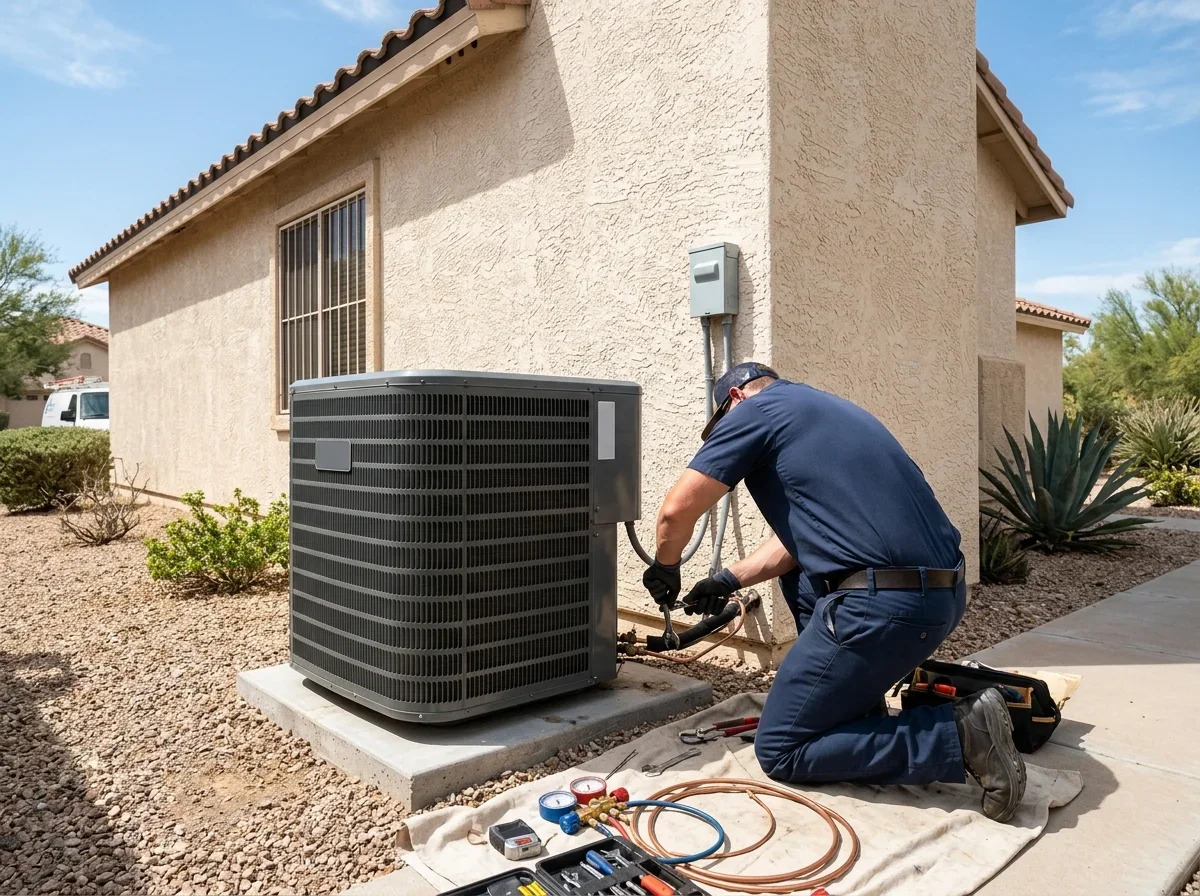
How much does AC replacement cost in Phoenix?
The total is a range, not a single average. It depends on system size, system type, duct condition, and how hard the install is. The table below shows each cost factor and the question to ask about it.
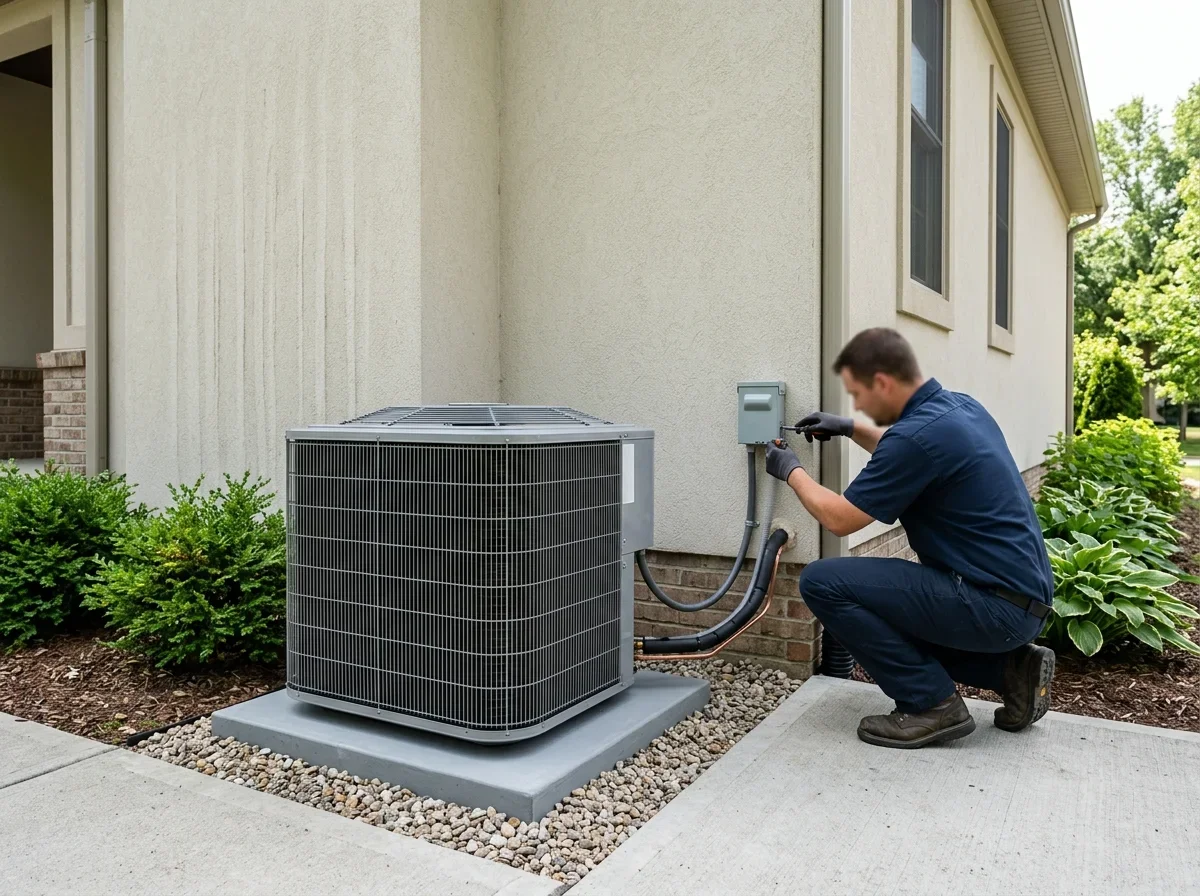
National guides don't agree with each other. Trane's cost page says a basic central AC replacement sits at the low end of its national range, while high-end systems cost considerably more. Carrier says HVAC replacement costs vary widely, from basic installs to very high-end systems.
For local context, Phoenix-area HVAC companies' own websites, checked October 2026, list standard central AC replacement at $7,000 to $12,000. One company lists heat pump replacement at $6,000 to $12,000.
Price range
Phoenix-area listed replacement prices
| Item | Low | High |
|---|---|---|
| Standard central AC replacement | $7,000 | $12,000 |
| Heat pump replacement | $6,000 | $12,000 |
Which number are you reading?
Before you compare any two figures, ask which of these each one is:
- Equipment only, with no labor
- Installed AC only
- Installed AC plus a furnace or heat pump
- Installed with ductwork and permit included
For tonnage-based pricing, see the 3, 4 or 5 ton cost guide. If heat pumps are on your list, the heat pump installation cost guide covers that side.
What makes up an AC replacement quote?
Every quote is a stack of line items. Two bids with the same bottom line can hide very different scopes.
Equipment
The equipment line covers the outdoor condenser, the indoor coil or air handler, the efficiency tier, and the brand line. A matched system, where the condenser and indoor unit are designed to work together, is the usual standard. Efficiency is rated in SEER2, and higher tiers cost more up front.
Ductwork and electrical
Ductwork is the biggest swing item. The average Phoenix-metro home dates to about 1985, so many have older duct systems.
Ask for a duct inspection before signing. Our ductwork repair, sealing and replacement page explains the options, and the attic duct replacement guide covers when repair isn't enough.
Pro tip
Ask every contractor to price the same duct scope, so you can compare bids that include ductwork with bids that leave it out.
Electrical items include the disconnect, the whip, the thermostat, and the pad or roof curb. Some bids list these separately and others fold them in.
Permit and labor
Labor covers crew time, crane or roof access, the refrigerant line set, haul-away of the old unit, startup, and warranty registration. A permit fee appears only where the city requires one.
What drives AC replacement cost in Phoenix
| Cost factor | What it covers | Why it moves the total | Ask your contractor |
|---|---|---|---|
| Equipment (condenser and coil or air handler) | Outdoor unit plus indoor coil or air handler | Brand line and build quality vary widely | Are the condenser and coil a matched set? Which model numbers? |
| Tonnage and system size | Cooling capacity of the system | Larger systems cost more and need matching ducts | How did you calculate the tonnage? |
| Efficiency tier | SEER2 rating and staging (single, two-stage, variable) | Higher tiers carry higher equipment cost | What SEER2 rating is quoted, and what stage type? |
| Ductwork repair or replacement | Sealing, plenum, returns, full runs | Older ducts may need work to deliver the new system's airflow | Which ducts are included, and why? |
| Electrical and thermostat | Disconnect, whip, wiring, thermostat | Code or equipment changes can require electrical work | Is the thermostat included? Any electrical changes? |
| Roof or ground placement and access | Pad, roof curb, crane, attic access | Difficult access adds crew time and equipment | Is crane or roof access included? |
| Permit | City permit fee, if required | Rules differ by city | Is the permit included, not needed, or extra? |
| Labor and startup | Install crew, line set, haul-away, commissioning | Scope differs between companies | What is included in startup and haul-away? |
| Warranty | Parts and labor coverage terms | Terms and registration rules differ | What do parts and labor coverage each include, and for how long? |
Why Phoenix homes price differently
Phoenix logged 113 consecutive days at or above 100°F in 2024, beating the 76-day record from 1993. Systems here run hard for months.
That makes warranty terms and equipment tier worth real attention. Ask what the warranty covers and whether the equipment suits that duty.
Local code also shapes the bid. Phoenix's amendments to the 2024 International Mechanical Code prohibit nonmetallic condensate piping in direct sunlight, such as on a roof, because heat softens it and it sags.
Phoenix's mechanical code (section 309.1, as amended) also requires systems able to maintain set indoor temperatures. That means sizing should rest on a load calculation, not just a copy of the old unit's tonnage.
Roof, ground, and attic air handler setups each change the labor, so ask whether a crane or roof access is part of the quote.
Scheduling can get tight in late spring and after the monsoon, so book early. If your system is limping but running, a winter replacement gives you more room to shop.
Key takeaways
- Phoenix-area companies list standard central AC replacement at $7,000 to $12,000
- Sizing should rest on a load calculation, not the old unit's tonnage
- Ask whether crane or roof access is part of the quote
- Book early in late spring and after the monsoon
Does AC replacement need a permit in Phoenix, Mesa or Scottsdale?
Rules differ by city for the same job.
| Jurisdiction | Rule for replacement |
|---|---|
| Phoenix | No permit for repair or replacement that doesn't increase size, capacity, or location |
| Mesa | No permit if the new unit uses the same or less electricity; changed electrical connections need one |
| Scottsdale | Minimum Mechanical Permit for like-for-like replacement |
| Unincorporated Maricopa County | Like-for-like can be web-issued; roof-mounted units get Technical review |
Tempe, Chandler, Gilbert, and Glendale have their own rules, so call the city's permit desk before you assume anything.
Ask which rule applies and who pulls the permit. For more detail, see does replacing your AC need a permit in the Phoenix metro.
How do you compare AC replacement quotes like for like?
Start with three written, in-person estimates. The Arizona Registrar of Contractors recommends that approach and says the contract should state the project description, price, permit responsibility, license number, and start and completion dates.[1]
Then compare each bid on the same points:
- Tonnage, and how it was calculated
- Model numbers for the condenser and indoor unit
- Efficiency rating (SEER2) and stage type
- Ductwork: included or not, and which runs
- Permit: included, not needed, or extra
- Condensate piping material, if the unit is on the roof
- Warranty terms for parts and labor
- Haul-away, thermostat, and startup
- Rebates or financing, listed separately from the installed price
Check APS rebates and SRP rebates directly rather than counting on a contractor's estimate.
Verify the contractor before you sign
A job this size requires a license. Arizona law requires one when the project exceeds $1,000 or needs a local permit.[3] The R-39 classification covers installing and repairing comfort air-conditioning and heating equipment.[2]
Confirm the class covers your contract work in the ROC's Contractor Search. Our guide to verifying an HVAC license walks through it.
For a home solicitation sale, A.R.S. 44-5004 allows cancellation until midnight of the third business day. More questions are in what to ask before hiring a Phoenix HVAC contractor.
Is it time to replace, or can you repair?
Age, repeat repairs, a major component failure, efficiency, and refrigerant type all point the decision. One expensive repair on a system with years left can make sense. Repeated repairs on an old system usually don't.
Two cases
Repair or replace
Case A: Repair
- One expensive repair
- System has years left
Case B: Replace
- Repeated repairs
- Old system
The repair or replace guide lays out the full decision method. If you decide to fix, see AC repair and the AC repair cost guide.
If replacement is the call, our AC replacement and installation page is the next step.
AC replacement cost FAQ
What is the average cost to replace an AC system?
There is no single Phoenix average. Phoenix-area HVAC companies' own websites, checked October 2026, list standard central AC replacement at $7,000 to $12,000.
National guides run wider, and Trane's national range is broad. See the cost overview.
What is the average lifespan of a house AC unit?
Lifespan depends on maintenance and runtime. Ask your contractor about age and service history, and keep up with AC tune-ups.
What is the most expensive part to replace on an AC unit?
The cost depends on the job, so get an itemized written quote. See the compressor replacement cost guide.
What is the 20 rule for air conditioning?
No source supports a standard "20 rule," so don't rely on one. Use the age, repair history, and efficiency checks in the repair or replace guide.
How much does an HVAC system cost compared with AC only?
A full system that adds a furnace or heat pump costs more than AC alone. One Phoenix company's site lists heat pump replacement at $6,000 to $12,000.
What does AC and furnace replacement cost together?
It depends on equipment, ductwork, and scope. Get itemized quotes that list each piece. See furnace and heating repair if a repair might do.
Does replacing an AC unit in Phoenix need a permit?
In Phoenix, no permit is needed if size, capacity, and location don't change. Other cities differ, so see the permit section and confirm with your city.
Questions
- Arizona Registrar of Contractors. "Before You Hire a Contractor." https://roc.az.gov/before-hire. Accessed October 16, 2026.
- Arizona Registrar of Contractors. "License Classifications." https://roc.az.gov/license-classifications. Accessed October 16, 2026.
- Arizona Registrar of Contractors. "Contracting in Arizona? Here’s What You Need to Know!." https://roc.az.gov/news/contracting-arizona-heres-what-you-need-know. Accessed October 16, 2026.
- Arizona Registrar of Contractors. "Applying for a License." https://roc.az.gov/applying-for-a-license. Accessed October 16, 2026.