What does AC compressor replacement cost in Phoenix?
Published 2026 guides put AC compressor replacement at roughly $800 to $4,650 installed across the U.S., depending on who is counting and what the figure includes. HVAC Project Cost reports $1,100 to $4,650, with a typical 3-ton system at $1,500 to $3,400.[1] HOMEFIXX reports most residential jobs at $1,350 to $3,850.[3]
Pick HVAC lists a usual installed range of $800 to $2,300.[2]
Price range
Published national installed ranges by source
| Item | Low | High |
|---|---|---|
| HVAC Project Cost | $1,100 | $4,650 |
| HOMEFIXX | $1,350 | $3,850 |
| Pick HVAC | $800 | $2,300 |
All of these are national figures, not Phoenix quotes.
| Situation | Cost range (2026) | What's included | What changes the price |
|---|---|---|---|
| Compressor only, in warranty (parts covered) | National: about $600 to $1,200 (Pick HVAC)[2]; $600 to $2,650 left for labor and refrigerant (HVAC Project Cost)[1] | Labor and refrigerant; the part itself is covered | Warranty terms, refrigerant quantity, who pays for the drier |
| Compressor only, out of warranty | National: about $1,300 to $2,500 (Pick HVAC)[2]; $1,200 to $2,800 total (Warranty Peace)[5] | Part, labor, refrigerant recovery and recharge | Tonnage and compressor type |
| Compressor plus related electrical parts | Depends on the job; one Phoenix company's site lists capacitor or contactor repair at $200–$600 (Phoenix-area HVAC companies' own websites, checked October 2026) | Compressor job plus start components changed together | Which parts are replaced and how many |
| New condensing unit (outdoor only) | Depends on tonnage and efficiency; get an itemized written quote | Outdoor unit, labor, refrigerant, startup | Matching to the indoor coil, refrigerant type |
| Full system replacement | National: $5,000 to $10,000 for systems over 12 years old or using R-22 (Warranty Peace)[5]; Phoenix-area company sites list standard central AC replacement at $7,000 to $12,000 | Outdoor unit, indoor coil, air handler or furnace as scoped, permits, startup | Equipment tier, tonnage, ductwork condition |
Why the ranges disagree
Some online figures cover only the part. Others bundle labor, refrigerant and electrical components. Refrigerant recovery, brazing, evacuation and recharge all take time.[4]
Phoenix adds context rather than a price premium. The city logged 113 consecutive days at or above 100°F in 2024, so compressors here run hard for months.[6]
What drives the price of a compressor quote?
Compare scope before price. Tonnage matters first, since a bigger system needs a bigger compressor and more refrigerant. Compressor type matters too, since two-stage and variable-speed units cost more than single-stage ones.
Price factors
What changes a compressor quote
Tonnage
A bigger system needs a bigger compressor and more refrigerant
Compressor type
Two-stage and variable-speed units cost more than single-stage
Warranty
Parts may be covered, but labor and refrigerant are typically separate
Refrigerant
A system that has leaked costs more than a clean swap
Warranty comes next. Even with a covered part, HVAC Project Cost notes that $600 to $2,650 may remain for labor and refrigerant.[1]
A complete compressor quote should itemize:
- The compressor and whether it is OEM, aftermarket or remanufactured
- Labor, including refrigerant recovery, brazing, evacuation and recharge
- A new filter-drier
- Start components or other electrical parts changed alongside it
- Permit, tax and disposal, if any
- Labor warranty and parts warranty terms
Refrigerant is the line that surprises people most. A system that has leaked will cost more than a clean swap.
Roof units take more effort than ground units. Maricopa County even reviews roof-mounted units as Technical/Standard Review, while ground-mounted new or upgraded units are Non-Technical.[7]
Is it worth replacing the compressor or the whole condensing unit?
The full comparison is covered in Repair or Replace Your AC? How to Decide in Phoenix. For the job itself, see AC compressor and capacitor replacement for repair and AC replacement and installation for a new system.
Warranty status
Start here, because it changes the math more than anything else. Ask the contractor to verify your serial number and warranty status before pricing the job.
Pro tip
Ask the contractor to show the manufacturer's warranty deduction as its own line, so you can see what labor, refrigerant and the drier still cost.
A part under warranty still leaves labor, refrigerant and the drier on your invoice in many cases.
The age and refrigerant question
Age is the second filter. The "cost rule" is a rule of thumb: multiply the system's age by the repair cost, and if the result passes the threshold you are comfortable with, lean toward replacing.
Lean toward replacement when the system is near the end of its expected service life, uses an older refrigerant such as R-22, has a leaking coil, or keeps failing. Warranty Peace places full replacement at $5,000 to $10,000 for systems over 12 years old or using R-22.[5]
Two cases
Replace or repair the compressor
Case A: Lean toward replacement
- System near the end of its service life
- Older refrigerant such as R-22
- Leaking coil
- Keeps failing
Case B: Repair is easier to defend
- System is young
- Part is covered
- Coil and refrigerant circuit are sound
Pairing a new outdoor unit with an old indoor coil can cause compatibility problems. If you are weighing refrigerant changes, R-454B explained covers what that means for your next AC.
How do I know it's really the compressor and not a capacitor?
Compressor trouble and electrical trouble look alike from the living room. Common signs of a bad compressor include:
- Hard starting
- A tripping breaker
- A humming sound with no start
- Warm air from the vents
- Loud or unusual noise from the outdoor unit
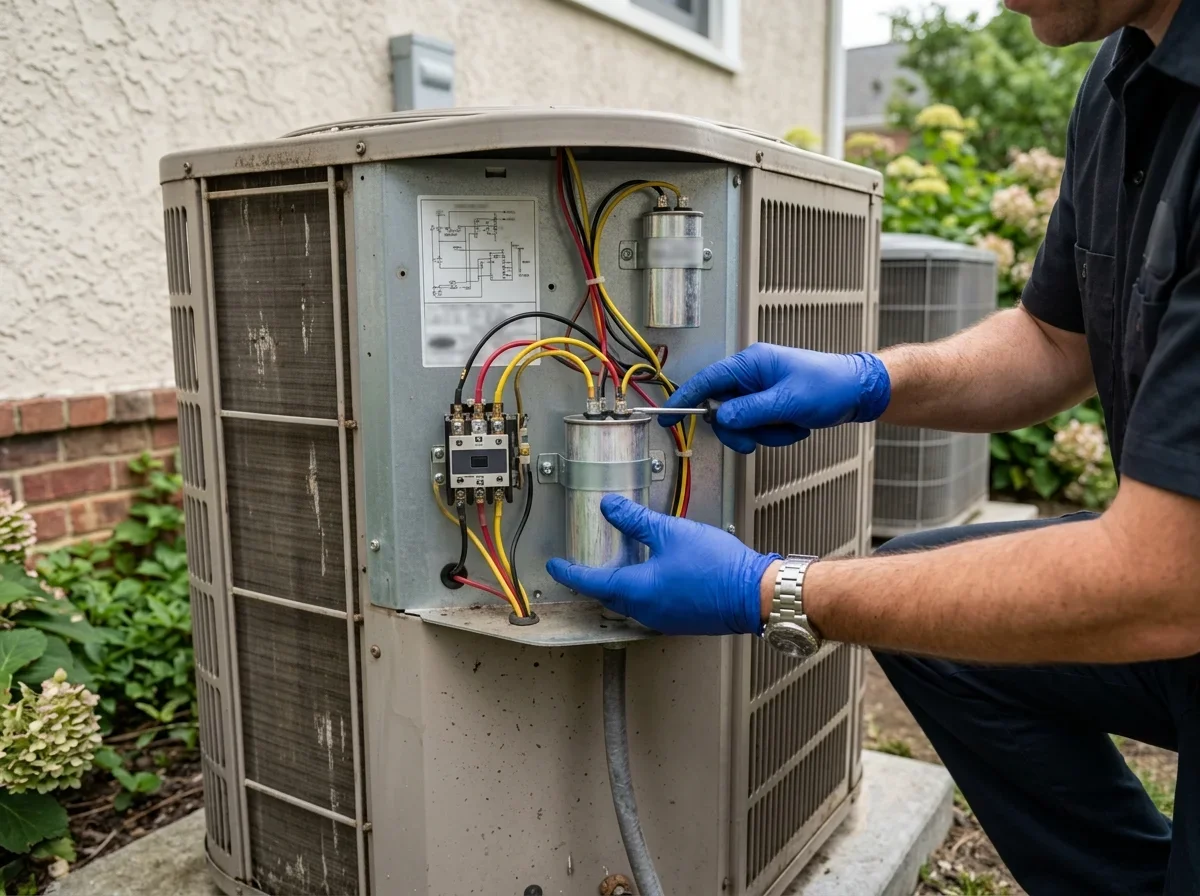
A weak capacitor can produce nearly every one of those symptoms, and the fix costs far less. One Phoenix company's site lists capacitor or contactor repair at $200–$600 (Phoenix-area HVAC companies' own websites, checked October 2026), against a major component repair at $1,000–$3,000+.
Side by side
Electrical part or major component
Capacitor or contactor
- Listed at $200–$600
- Can mimic nearly every compressor symptom
Major component repair
- Listed at $1,000–$3,000+
- Confirm with measured readings first
Ask for numbers, in writing, before you approve a compressor job:
- Compressor amp draw compared with the nameplate RLA
- Capacitor microfarad reading compared with its rated value
- Contactor condition
- Voltage at the unit
- Refrigerant pressures and any leak evidence
Get a second opinion before any compressor quote, especially one built on a high-amp-draw diagnosis.
Key takeaways
- Published national ranges run from $800 to $4,650, and none are Phoenix quotes
- A weak capacitor or contactor can mimic a bad compressor for $200–$600
- Check warranty status first; labor and refrigerant often remain
- Ask for measured readings and an itemized written quote
If your unit simply will not start, AC won't turn on: breaker, capacitor and contactor checks walks through the basics.
Permits, licensing and what to check in a Phoenix-area quote
A short checklist before you sign:
- Check the ROC record. Look the contractor up at roc.az.gov/before-hire. Confirm the license is active and the class covers residential HVAC (R-39, R-39R or CR-39 type; C-39 and C-58 are commercial).[8]
- Ask about insurance. A license does not guarantee insurance, so ask for certificates and call the insurer.
- Confirm credentials. Refrigerant handling requires EPA Section 608 certification. See what HVAC credentials mean.
- Get a written contract. It should show the license number and start and completion dates.
- Know your cancellation right. A home solicitation sale carries a three-business-day right to cancel under A.R.S. 44-5004.
More detail sits in How to verify an HVAC contractor's license in Arizona.
Permit rules by city
Permit rules differ by city for the same kind of job:
- Phoenix: no permit for repair or replacement that does not increase unit size, capacity or location.
- Mesa: no permit to replace an AC unit using the same or less electricity; changing electrical connections needs one.
- Scottsdale: a Minimum Mechanical Permit is required for like-for-like replacement of an AC or air handler in the same location.
- Unincorporated Maricopa County: like-for-like HVAC replacement can be web-issued online.
The permit guide for Phoenix-area AC replacement goes further.
Frequently asked questions
Is it worth replacing an AC compressor?
It can be, when the system is young, the part is under warranty and the rest of the system is sound.
What is the cost rule for AC?
It is a rule of thumb: multiply the system's age by the repair cost. It is a gut check, not a standard.
What is the lifespan of an AC compressor?
Lifespan depends on the brand, installation and maintenance. Phoenix systems run for months at a time, which is a good reason to keep up with AC tune-ups and maintenance.
What are signs of a bad AC compressor?
Hard starting, a tripping breaker, humming, warm air and loud noise are the usual signs.
Is a compressor-only replacement a fair price?
Ask for an itemized written quote and compare scope line by line.
Does a warranty cover compressor labor?
Manufacturer parts coverage may cover the compressor but usually does not cover labor or refrigerant.
Questions
- HVAC Project Cost. "AC Compressor Replacement Cost 2026 - HVAC Project Cost." https://hvacprojectcost.com/ac-compressor-replacement-cost/. Accessed October 16, 2026.
- Pick HVAC. "AC Compressor Prices and Installed Cost (By Ton and By Brand)." https://www.pickhvac.com/central-air-conditioner/troubleshoot/ac-compressor-prices-and-installed-cost/. Accessed October 16, 2026.
- HOMEFIXX. "AC Compressor Replacement Cost 2026 - HOMEFIXX." https://www.homefixx.com/blog-posts/ac-compressor-replacement-cost. Accessed October 16, 2026.
- HOMEFIXX. "AC Compressor Labor Cost 2026: $450-$2,200 Real Contractor." https://www.homefixx.com/blog-posts/home-ac-compressor-replacement-labor-cost. Accessed October 16, 2026.
- Warranty Peace. "Frequently Asked Questions." https://warrantypeace.com/articles/ac-compressor-replacement-cost-2026. Accessed October 16, 2026.
- NBC News. "A summer marked by extreme, record-setting heat." https://www.nbcnews.com/science/environment/summer-extreme-heat-records-rcna171707. Accessed October 16, 2026.
- Maricopa County. "Construction Permit Information." https://www.maricopa.gov/1629/Construction-Permit-Information. Accessed October 16, 2026.
- Arizona Registrar of Contractors. "License Classifications." https://roc.az.gov/license-classifications. Accessed October 16, 2026.