How much does heat pump installation cost in Phoenix?
The one Phoenix-area figure we can put behind a name is a heat pump replacement listed at $6,000 to $12,000, taken from Phoenix-area HVAC companies' own websites, checked October 2026. That is a starting point for a straightforward swap, not a quote.
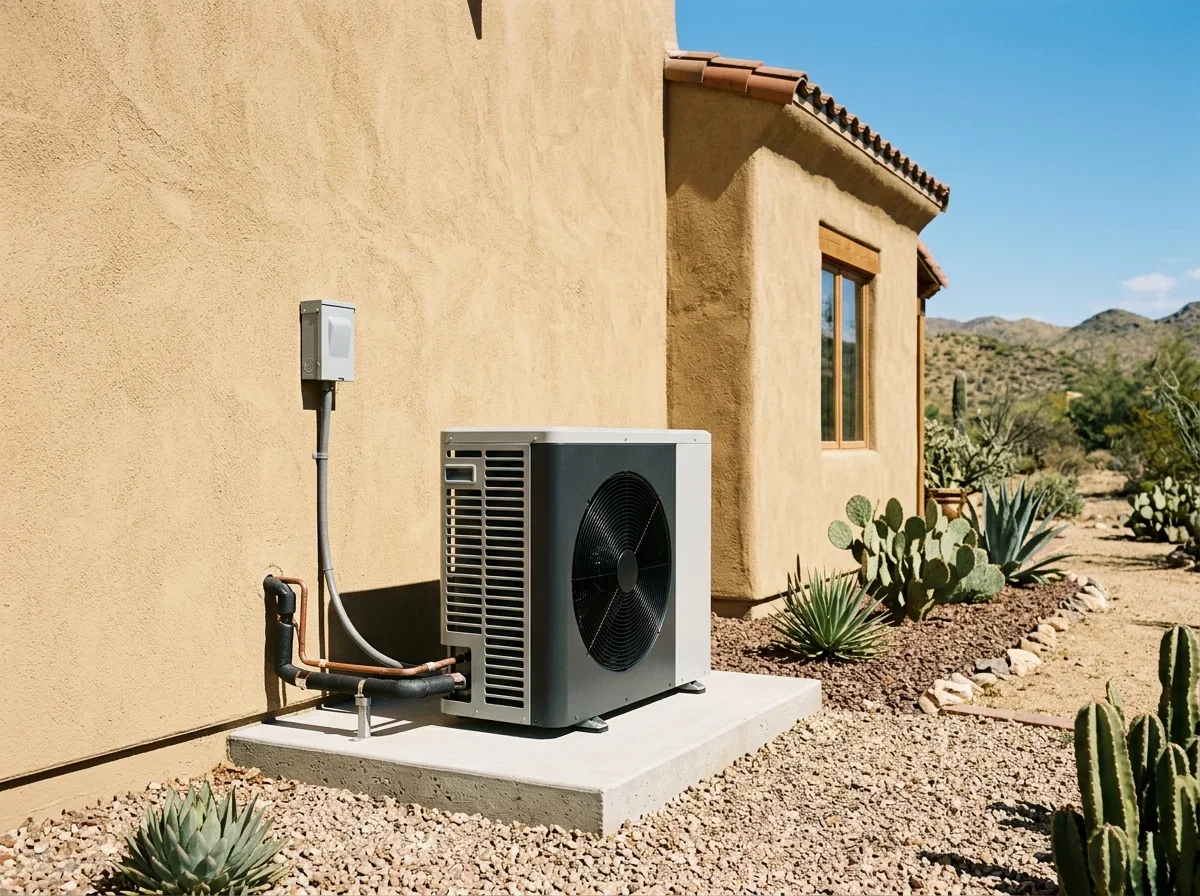
The table below breaks the cost into system types and shows where the number depends on your house.
National pages are too wide to budget from. Installation cost for a ducted heat pump depends heavily on factors like cold-climate models and backup heat, so ask each installer to break out those line items in the quote.
In Phoenix, cooling load drives the equipment choice. Your bid will turn on tonnage, efficiency tier, and what your ducts can handle.
| System type | Typical installed range | What is included | Best fit for |
|---|---|---|---|
| Split system, single-stage | Not separately priced; heat pump replacement listed at $6,000 to $12,000 by Phoenix-area company websites (Oct. 2026) | Outdoor unit, indoor coil or air handler, labor, refrigerant lines; permit and pad vary by quote | Straightforward replacement with sound ducts |
| Split system, two-stage | Depends on brand and scope; get an itemized written quote | Same as above, with a two-stage compressor | Homes wanting steadier comfort without top-tier pricing |
| Split system, variable-speed | Depends on brand and scope; get an itemized written quote | Same as above, with inverter-driven equipment | Homes prioritizing efficiency and humidity control |
| Package unit (rooftop or slab) | Depends on access and setup; get an itemized written quote | Single outdoor cabinet, labor, and possibly curb, pad, or duct adapters | Homes with an existing roof or slab package unit |
| Ductless mini-split | See mini-split installation costs in Phoenix | Outdoor unit, indoor heads, line sets, labor | Additions, ductless homes, or zoned comfort |
| Add-ons: duct repair, electrical, permit | Depends on the job; priced as separate line items | Duct sealing or replacement, electrical changes, permit fees | Older homes or changed equipment type |
The heat pump vs. central AC breakdown covers that decision, and the AC replacement cost guide gives you the baseline.
What drives the price of a heat pump install?
Three things move a Phoenix bid more than anything else: how big the system is, what condition your ducts are in, and what the city requires for electrical and permit work.
Price factors
What moves a Phoenix bid
System size and efficiency
Tonnage from a load calculation and a higher SEER2 or HSPF2 tier generally cost more
Ductwork condition
Leaky or undersized runs can raise the bid or change the scope
Electrical and permit work
City rules and slab trenching through caliche can add cost
System size and efficiency
Tonnage should come from a load calculation, not a square-footage guess. ACCA's Manual J is the standard method, and a contractor who skips it may simply copy your old unit's size.
Phoenix logged 113 consecutive days at or above 100°F in 2024, so an undersized system struggles and an oversized one short-cycles and handles humidity poorly.
Efficiency tier is the second lever. Higher SEER2 and HSPF2 ratings generally cost more up front.
Ask for each tier as a separate option so you can see what the upgrade costs. For sizing by tonnage, the AC unit cost by tonnage guide is a useful reference.
Pro tip
Ask every contractor to price the same tonnage and the same efficiency tier, then request an upgraded tier as a separate line so the added cost is easy to see.
Ductwork condition
The average Phoenix-metro home dates to 1985, and attic ducts bake in extreme heat for years. Leaky or undersized runs can push a bid up or force a change of scope partway through the sales process.
Ask for a duct evaluation, including airflow and leakage testing, before approving anything. If repair or replacement is on the table, see the ductwork repair, sealing and replacement page for what that work involves.
Electrical and permit work
Permit rules differ by city, and a heat pump swap can trigger paperwork an AC swap would not. Check with your city before comparing bids:
| Jurisdiction | Permit rule for replacement |
|---|---|
| Phoenix | No permit for repair or replacement that does not increase size, capacity, or location |
| Mesa | No permit if the new unit uses the same or less electricity; changed electrical connections need one |
| Scottsdale | Minimum Mechanical Permit, even for like-for-like |
| Unincorporated Maricopa County | Web-issued permit for like-for-like; roof-mounted units get Technical/Standard Review |
Tempe, Chandler, Gilbert, and Glendale rules vary, so confirm with your city's permit desk. For more detail, read whether AC replacement needs a permit in the Phoenix area.
Slab-on-grade homes add one more wrinkle. Caliche, the hardpan layer found 1 to 6 feet down, can make trenching for new line sets or electrical runs far costlier than normal soil.
Package unit or split system: how does cost differ?
A package unit holds every major component in one outdoor cabinet, which is why it is common on Phoenix roofs and slabs. A split system pairs an outdoor unit with an indoor air handler or coil.
Side by side
Package unit versus split system
Package unit
- All components in one outdoor cabinet
- Common on Phoenix roofs and slabs
Split system
- Outdoor unit plus indoor air handler or coil
- Refrigerant lines connect the two
Swapping like for like is usually simplest. Converting from one format to the other brings extra material and labor.
Two cases
Swap type and what it involves
Case A: Like for like
- Usually the simplest swap
- Existing setup carries over
Case B: Format conversion
- Extra material and labor
- Scope changes with the new format
Roof-set units may involve crane or roof access, a curb, and duct adapters. The bid should say how the unit will be set on your roof type, whether flat block-home roofs or tile.
Phoenix's amended 2024 International Mechanical Code (Ordinance G-7397, effective August 1, 2025) also bars nonmetallic condensate piping in direct sunlight, such as on roofs, because extreme heat softens it.
On the "4 ton heat pump package unit" question: tonnage describes cooling capacity, and what four tons actually covers depends on your home's load, insulation, windows, and ducts.
Considering going ductless instead? The mini-split installation cost page covers that route.
Can federal incentives or utility rebates lower the price?
Possibly, but verify before you count on anything.
The IRS lists electric heat pumps among qualified improvements under the Energy Efficient Home Improvement Credit, and eligible costs may include installation labor.[2] The IRS describes a credit of up to $2,000 per year, equal to 30% of eligible costs, subject to the requirements and tax-year availability on its page.[3]
IRS tax-preparation guidance also identifies a $3,200 maximum total annual credit across covered improvement categories.[4] Check the IRS page for the current end date and eligibility for 2026.
Utility rebates are separate. SRP lists residential heat pump rebates of $75 per ton for single-stage systems, $150 per ton for multi-stage, and $225 per ton for variable-capacity systems. The rebate must be submitted within 6 months of installation.[1]
Price range
SRP heat pump rebate per ton
| Item | Low | High |
|---|---|---|
| Single-stage | 75 USD per ton | 75 USD per ton |
| Multi-stage | 150 USD per ton | 150 USD per ton |
| Variable-capacity | 225 USD per ton | 225 USD per ton |
For APS customers, confirm amounts, equipment criteria, and deadlines on aps.com. You can also see the APS rebates guide and SRP AC rebates guide.
Confirm that the exact model and efficiency tier qualify before you sign.
How do I get a fair bid from a licensed contractor?
Headline prices are rarely apples-to-apples. One bid may include duct testing, a permit, and startup, while another leaves them out.
Use this checklist to level the field:
- Look up the license. Use the Arizona Registrar of Contractors' before-you-hire page to confirm an active license.
- Check the class. It should cover the work, such as R-39 or CR-39. R-39R subclassifications no longer take new applications.
- Ask for proof of insurance. A license does not guarantee it. The ROC requires workers' compensation but no other insurance for a license.
- Ask who pulls the permit. Also ask which city rule applies. Mesa asks permit applicants for an ROC license number.
- Get a written contract. It should show the license number and start and completion dates.
- Pay safely. Make checks payable to the company named in the contract, and do not pay cash.
Bond limits are worth knowing. Specialty residential bonds run only $1,000 to $7,500, and residential and dual-licensed contractors must post an additional $200,000 bond or participate in the Residential Contractors' Recovery Fund.
A claim must be filed within two years after proceedings and appeals end. If a sale happens at your home, Arizona law (A.R.S. 44-5004) gives you three business days to cancel.
Then compare itemized bids for the same capacity, efficiency level, and scope. Our guide to questions to ask before hiring can help.
For quotes, see heat pump installation and repair.
Heat pump installation cost FAQ
How much does it cost to service a heat pump?
Phoenix-area HVAC companies' own websites list diagnostic or service-call fees that most commonly run $70 to $90, with a full spread of $59 to $119 (checked October 2026). Several say the fee is waived or credited if you approve the repair.
What is the lifespan of a heat pump?
Lifespan depends on maintenance and how hard the system runs. Phoenix's long cooling season means heavy use, so check the manufacturer's warranty terms and ENERGY STAR or DOE guidance for the model you are considering.
What size heat pump do I need?
It depends on your home's load, not just square footage. Insist on an ACCA Manual J calculation, which accounts for insulation, windows, ducts, and sun exposure.
Does it cost a lot to run a heat pump?
Operating cost depends on efficiency rating, duct condition, thermostat habits, and your utility rate plan. In Phoenix, cooling dominates the bill, so higher-efficiency equipment and tight ducts matter more than heating performance.
Is there a federal tax credit for a heat pump, and is there an HVAC tax credit in 2026?
The IRS describes a credit for qualifying heat pumps, up to $2,000 per year at 30% of eligible costs, but availability depends on the tax year and requirements on its page.[3]
Check IRS.gov for 2026 status and consult a tax professional.
What does a 4 ton heat pump package unit cost and cover?
Cost depends on the efficiency tier, roof or slab setup, and any duct or electrical changes, so get an itemized quote. What four tons covers is set by a load calculation, not square footage.
Questions
- Salt River Project (SRP). "Air conditioner (AC) rebates." https://www.srpnet.com/energy-savings-rebates/home/rebates/air-conditioner. Accessed October 16, 2026.
- Internal Revenue Service. "How to claim an energy efficient home improvement tax credit." https://www.irs.gov/credits-deductions/how-to-claim-an-energy-efficient-home-improvement-tax-credit-residential-energy-property. Accessed October 16, 2026.
- Internal Revenue Service. "Energy Efficient Home Improvement Credit." https://www.irs.gov/credits-deductions/energy-efficient-home-improvement-credit. Accessed October 16, 2026.
- Internal Revenue Service. "Energy Credits Content." https://apps.irs.gov/app/vita/content/26s/26_03_026.jsp?level=basic. Accessed October 16, 2026.