What does an HVAC maintenance plan include?
A maintenance plan is a service agreement: you pay a recurring fee, and the company performs scheduled tune-ups and inspections. Common extras are repair discounts, priority scheduling and waived diagnostic fees.
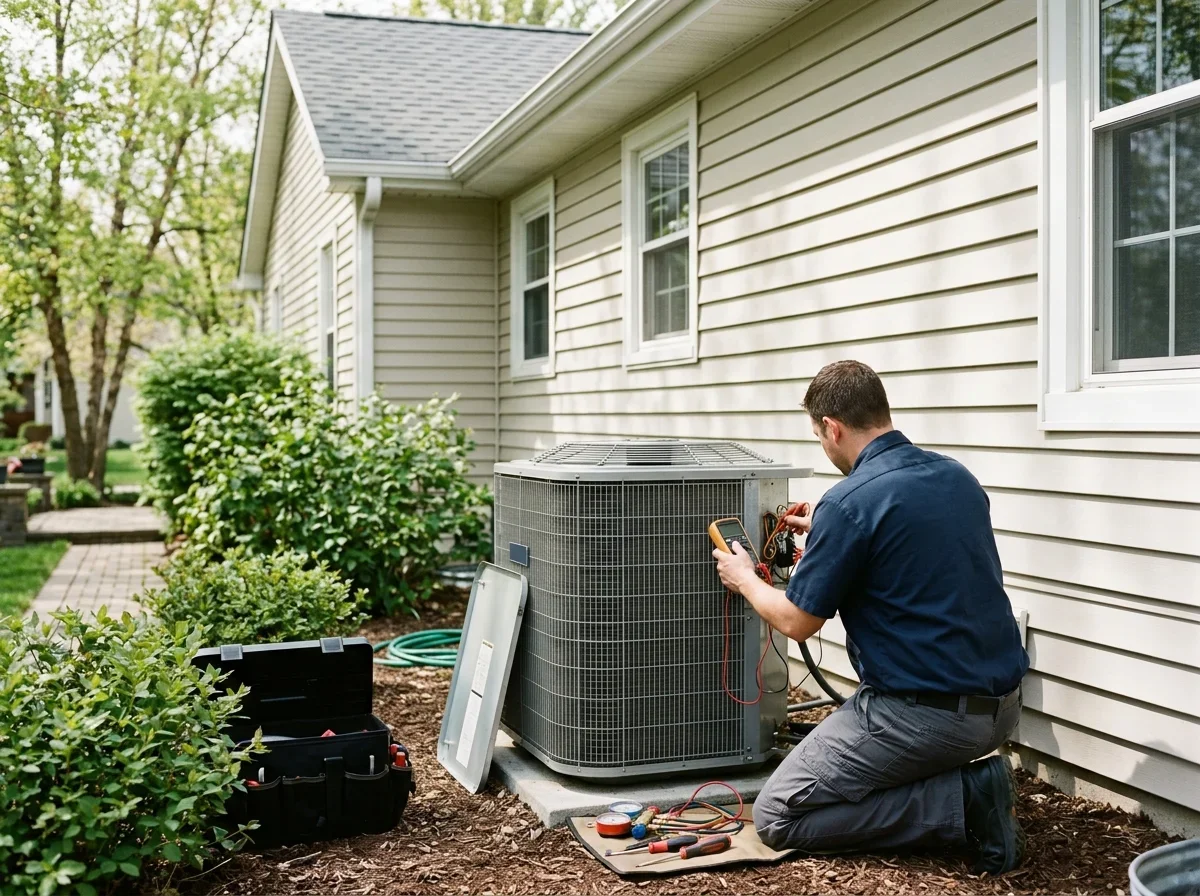
A plan visit is not repair coverage. Unless the contract says so, parts, refrigerant and major repairs are billed to you.
Side by side
Plan visit versus repair costs
Usually in the plan
- Scheduled tune-ups and inspections
- Repair discounts
- Priority scheduling
- Waived diagnostic fees
Usually billed to you
- Parts
- Refrigerant
- Major repairs
Get the visit defined in writing too. Coil and condenser cleaning, electrical testing, capacitor checks, drain inspection, airflow checks and a written findings report are very different from a quick visual look. AC tune-up and maintenance explains what a thorough visit involves, and filter replacement in Phoenix homes covers the filter visits many plans include.
If the plan includes heating, check which furnace repairs it discounts. Common furnace failures lists the parts that tend to be involved.
What do home and equipment warranties actually cover?
Three different things get called a "warranty."
A manufacturer warranty covers defective parts for a set period. An installer labor warranty covers the workmanship of whoever put the system in. A third-party home warranty is a service contract that pays for covered repairs after you file a claim.
Read each one's exclusions. Labor, refrigerant, pre-existing conditions, unregistered equipment and missing maintenance records are the usual trouble spots.
Pull the exact warranty document for your brand and check whether registration is required and whether skipped maintenance can void a claim. Keep invoices, filter receipts and tune-up reports in one folder. If you are buying new equipment, ask about warranty terms during AC replacement and installation quotes, and ask who pulls any required permit.
| Manufacturer warranty | Installer labor warranty | Maintenance plan | Third-party home warranty | |
|---|---|---|---|---|
| Routine tune-ups | Not covered | Not covered | Covered, per the visit count in the contract | Not covered, or only sometimes offered as an add-on |
| Parts repairs | Covered for defective parts, within the term | Not covered, workmanship only | Not covered unless stated; discounts are common | Sometimes covered, subject to limits and approval |
| Labor | Often not covered | Covered for the installer's own work | Sometimes discounted | Sometimes covered, with service-call fees |
| Refrigerant | Often not covered | Not covered | Usually not covered | Often excluded or capped |
| Priority service | Not covered | Not covered | Sometimes; check for a written response window | Not covered; contractor is typically assigned |
| Common exclusions | Misuse, unregistered units, neglect | Work by other contractors | Parts, refrigerant, replacement | Pre-existing conditions, code upgrades, access work |
| Maintenance records required | Often | Rarely | Not applicable | Sometimes, to defend against denial |
How much does an HVAC maintenance plan cost?
Phoenix-area HVAC companies' own websites, checked October 2026, list plans in several forms. Annual plans cost less than monthly ones, and the exact price depends on the provider and the coverage level.
Many companies advertise a single tune-up for $49.95 to $89. Diagnostic fees most often run $89 to $99, with some waived when you approve the repair.
Visits per year, number of systems, tier level and the repair discount all move the number. Compare tiers by what they include: guaranteed visits, which season they fall in, waived fees and whether any labor is covered.
If the main perk is a discount you may never use, a plan is hard to justify.
Is a maintenance plan worth it in Phoenix?
It can be, mostly because of priority service. Phoenix logged 143 days at or above 100°F in 2024,[4] including a record 113 consecutive days,[5] so systems run hard and a breakdown is urgent.
"Priority" is only a word unless the contract defines it.
Ask for a maximum response window, and whether it is hours or business days. Ask about weekend and after-hours policy. If the contract only says "priority," you are buying a promise with no measure behind it.
Pro tip
Ask for the response window in writing, stated in hours or business days, including weekends and after-hours calls.
Plans fit best for older systems, multiple units or heavily used equipment. They fit poorly for a newer, lightly used unit. For what a breakdown costs without a plan, see AC repair and 24-hour emergency AC repair.
Key takeaways
- A plan is a service agreement, not repair coverage
- Priority service only counts if the contract defines a response window
- Plans fit older, multiple or heavily used systems best
- Compare tiers by what they include, not just price
What fine print should you read before signing?
Ask for the full contract before paying. Then run this checklist:
- Does the plan auto-renew, and can the price rise at renewal?
- How do you cancel, and are unused visits refundable?
- Is the plan transferable if you sell the home?
- How many visits are guaranteed, and in which seasons?
- What is the written response window for priority calls?
- Which parts are "covered," and are labor and refrigerant included?
- Do discounts apply to labor, parts, refrigerant, after-hours work and permits?
Ask for a diagnosis, measurements and an itemized estimate before authorizing anything.
Arizona also has a cooling-off rule. For qualifying home solicitations of $25 or more, you can generally cancel until midnight of the third business day after signing.[1] Confirm how it applies to your sale.
How do you check the company behind the plan?
A plan is only as good as the company honoring it. Verify before you pay:
- Search the company on the Arizona Registrar of Contractors (ROC) contractor search at roc.az.gov.
- Confirm the license is active.
- Confirm the class covers HVAC work (R-39, R-39R or CR-39 type).
- Match the legal name and license number to the contract.
For a full walkthrough, see how to verify an HVAC contractor's license in Arizona and what homeowners need to know about the ROC HVAC license.
A license does not prove insurance. Ask for certificates and call the insurer to confirm coverage. HVAC credentials explained breaks down trade credentials.
If a dispute arises, the ROC handles complaints. Eligible residential homeowners may have access to the Residential Contractors' Recovery Fund.[2] The fund pays out per violation and per contractor license, up to set limits.[3]
FAQ: HVAC maintenance plans and warranties
Are HVAC maintenance plans worth it?
Sometimes. They pay off for older, heavily used or multiple systems when priority service has a written response window.
Does a home warranty cover HVAC maintenance?
Usually not. A home warranty is built around approved claims for covered failures, not scheduled upkeep.
What is a good preventative maintenance program for HVAC?
A good program has a written checklist, a cooling visit before May, and a post-summer or heating check.
How do you do maintenance on an HVAC unit?
Between professional visits, change filters on schedule, keep the outdoor unit clear of debris and watch the drain line. See how often to change your filter.
What is the $5,000 rule for HVAC?
It is a repair-versus-replace rule of thumb, and no source reviewed here confirms its details. Repair or replace your AC walks through the decision.
Are HVAC prices going up in 2026?
No 2026 source is cited here, so confirm current pricing directly. Browse the services index to find the right service category.
- Arizona Attorney General’s Office. "Door-To-Door Sales." https://www.azag.gov/consumer/tips/door-door-sales. Accessed October 16, 2026.
- Arizona Registrar of Contractors. "Complaint Process Recovery Fund." https://roc.az.gov/complaint-process-rf. Accessed October 16, 2026.
- Arizona Registrar of Contractors. "Agency." https://roc.az.gov/agency. Accessed October 16, 2026.
- National Weather Service, Phoenix Office. "2024 Climate Year in Review for Phoenix, Yuma, and El Centro." https://www.weather.gov/psr/yearinreview2024. Accessed October 16, 2026.
- Associated Press. "Phoenix ends its streak of 100-degree days at 113 consecutive days." https://apnews.com/article/phoenix-summer-heat-cooler-temperatures-6a0093da70f5887336fdf5b2c75c07f9. Accessed October 16, 2026.