How often should you change your AC filter in Phoenix?
Check the filter monthly through the cooling season, and replace it based on your household, not the calendar. The EPA says manufacturers typically recommend replacing filters every 60 to 90 days, but heavily soiled filters need changing more often.[2] The table below adjusts that baseline for Phoenix homes.
Here is why the generic rule runs short here. Phoenix recorded 113 consecutive days at or above 100 degrees in 2024, shattering the old record of 76 days set in 1993.[7] Your system can run most days from roughly May through October.
A filter rated for 90 days may be loaded well before then, because the blower moves air far more hours than the package assumes. The Department of Energy advises that filters be cleaned or replaced monthly during seasons of peak use.[1]
Suggested filter change timing by Phoenix household
| Household situation | Check how often | Typical replacement interval | Why |
|---|---|---|---|
| No pets, standard 1-inch filter | Monthly in the cooling season | Baseline of 60 to 90 days per EPA; lean toward the short end in summer[2] | Long daily run times load the filter faster than the baseline assumes. |
| One or two pets | Monthly | Sooner than the baseline; replace when the media looks matted with hair and dust | EPA says heavily soiled filters need more frequent replacement.[2] Shedding adds load. |
| Allergy sufferers | Monthly | Replace at the first sign of loading rather than stretching to 90 days | A loaded filter helps no one, and a very restrictive one can choke airflow.[4] |
| Dusty area or nearby construction | Check often during dusty months | Replace when visibly gray; do not wait for the schedule | Desert dust, construction dust and sandy valley soil all reach the return air. |
| Vacant or seasonal home | On each visit | Check on each visit and replace if dirty | Little airflow means slower loading, but dust still settles in. |
| Thick media filter (4-5 inch) | Quarterly, or per the label | Follow the manufacturer's label | Deeper media has more surface area, and intervals vary by product.[5] |
Pets and heavy shedders
Multiple dogs can load a 1-inch filter far faster than a quiet household would.
Spring start and monsoon checks
Put in a fresh filter before the cooling season ramps up in spring. Then check again after monsoon dust storms in July through September.
How do you tell if your AC filter needs replacing?
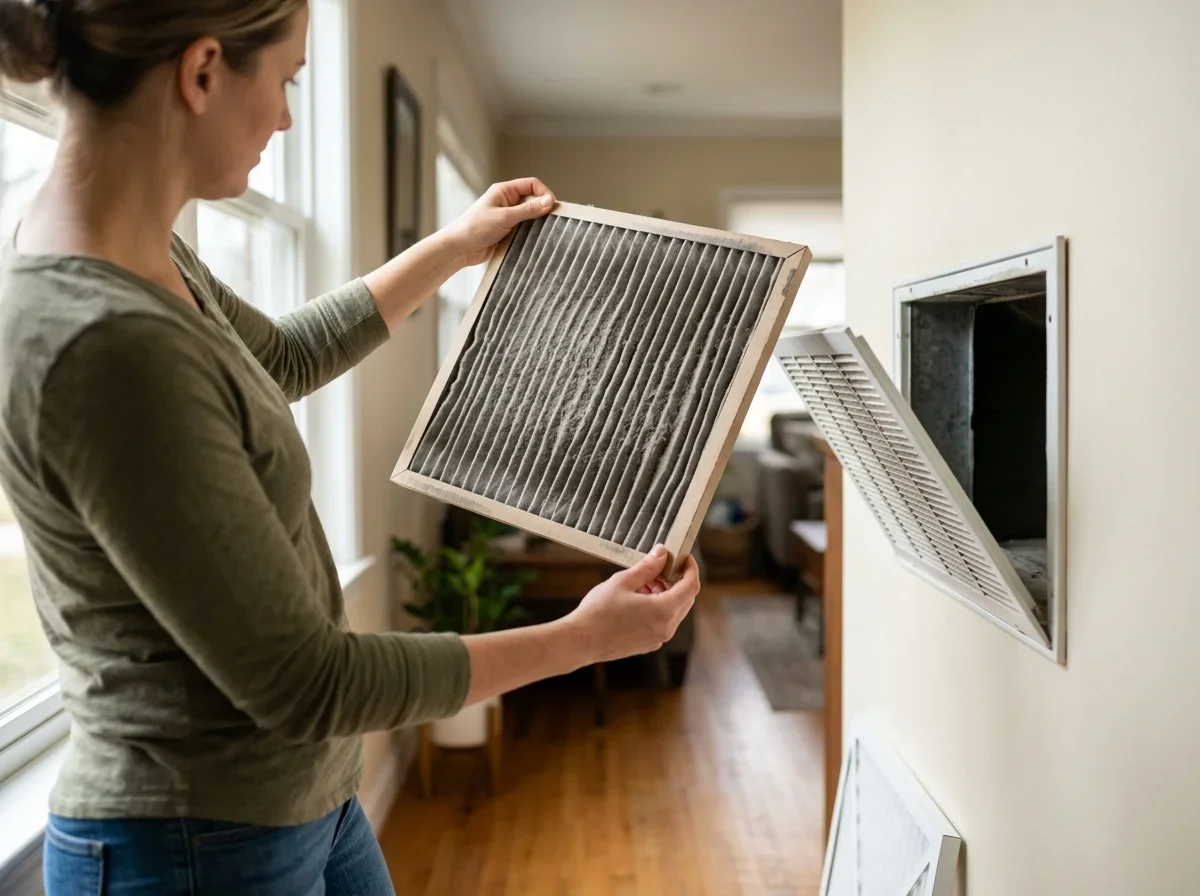
Pull the filter and hold it up to a light. If you can't see light through it, or you see a gray mat of dust, sagging media or a warped frame, change it.
Then watch for symptoms:
- Weak airflow at the vents
- Rooms that cool slowly
- More dust on surfaces
- The system running longer than usual
A clogged filter can reduce airflow, lengthen runtime, and add motor wear and energy use.[4]
Checklist
Signs it is time to change the filter
0 of 6 ticked
Tick them off as you go. Nothing is saved or sent.
If airflow is still weak after a fresh filter, our guide to an AC that stopped cooling in a heat wave walks through what to check next.
What filter size and MERV rating should you buy?
Getting the size right
Read the size printed on the frame of your old filter. Match the nominal size, or measure carefully if the old filter is missing or unmarked.
EPA advises a snug fit so air can't slip around the filter.[2] Never force in an oversized filter or stack two filters.
MERV versus airflow
MERV measures how well a filter captures particles from 0.3 to 10 microns. EPA advises choosing the highest rating your fan and filter slot can accommodate.[3] Higher-MERV filters tend to restrict airflow more.[4]
MERV 8 is a common default. EPA recommends MERV 13 only where the system is compatible, after checking the equipment manual or asking an HVAC professional.[6] EPA groups MERV 5 through 13 as medium-efficiency filters that generally allow more airflow than HEPA.[5]
| Rating | How it is described | Guidance |
|---|---|---|
| MERV 5 through 13 | Medium-efficiency | Generally allows more airflow than HEPA |
| MERV 8 | Common default | A typical starting choice |
| MERV 13 | Higher filtration | Only where the system is compatible; check the manual or ask an HVAC professional |
If you want finer filtration, a deeper media filter in a system designed for it is the safer route. A technician during AC tune-up and maintenance can confirm your system's limit.
Side by side
Filtration versus airflow
Higher MERV
- Catches smaller particles
- Tends to restrict airflow more
Lower MERV
- Catches larger particles
- Generally allows more airflow
Can a wrong or dirty filter damage your AC?
Restricted airflow can contribute to a frozen evaporator coil, and thawing ice can overwhelm the drain pan.[4] If you see ice or puddles, read about AC leaking water for causes and drain line fixes.
How it works
How a dirty filter leads to water problems
Step 1: Dirty filter restricts airflow
Step 2: Evaporator coil can freeze
Step 3: Thawing ice overwhelms the drain pan
Puddles may appear
A wrong-size filter lets unfiltered dust bypass the media and coat the coil and blower.
If airflow stays weak after you install a fresh, correctly sized filter, a tune-up visit makes sense for diagnosis.
Can you change your AC filter yourself?
Yes. It is one of the simplest maintenance jobs in the house.
- Switch the system off at the thermostat.
- Find the airflow arrow on the frame of the old filter.
- Slide the old filter out.
- Insert the new one with the arrow pointing toward the blower or air handler.
- Write the date on the frame.
If yours is in the attic, change it in the early morning, use a stable ladder and shut the system off first. Some HVAC maintenance plans include filter changes.
Step by step
Changing the filter
Switch off
Turn the system off at the thermostat.
Note the arrow
Find the airflow arrow on the old filter's frame.
Swap
Slide the old filter out and insert the new one with the arrow toward the blower or air handler.
Date it
Write the date on the frame.
A filter swap needs no permit. Our guide on AC replacement permits covers where the rules begin.
How much does AC filter replacement cost?
Price depends on size, thickness and MERV rating. Check current retail listings for your exact size. Multipacks and delivery subscriptions can lower the per-filter cost.
When you hire anyone, verify the license at the Arizona Registrar of Contractors (roc.az.gov/before-hire) and confirm an active HVAC class (R-39, R-39R or CR-39) matches the work. For more, see how to verify an HVAC contractor's license.
Frequently asked questions
How often should an AC air filter be changed?
EPA says manufacturers typically recommend every 60 to 90 days, with more frequent changes for heavily soiled filters.[2] In Phoenix, check monthly during the cooling season.
Can you change your AC filter yourself?
Yes. Turn the system off, note the airflow arrow, swap the filter and date it.
How do I tell if my AC filter needs replacing?
Hold it up to the light. A visible dust mat, gray color or sagging means change it.
How much does AC filter replacement cost?
It depends on size, thickness and MERV, so check current retail listings.
Does a higher MERV filter make my AC work harder?
How often should I change my AC filter if I have pets?
Check monthly, and expect to replace sooner than the 60 to 90 day baseline.[2]
Questions
- U.S. Department of Energy. "Guide to Home Heating and Cooling." https://www.energy.gov/sites/prod/files/guide_to_home_heating_cooling.pdf. Accessed October 16, 2026.
- U.S. Environmental Protection Agency. "Guide to Air Cleaners in the Home." https://www.epa.gov/indoor-air-quality-iaq/guide-air-cleaners-home. Accessed October 16, 2026.
- U.S. Environmental Protection Agency. "What is a MERV rating?." https://www.epa.gov/indoor-air-quality-iaq/what-merv-rating. Accessed October 16, 2026.
- U.S. Environmental Protection Agency. "Indoor airPLUS Technical Bulletin: Filtration." https://nepis.epa.gov/Exe/ZyPURL.cgi?Dockey=P100ZHX8.txt. Accessed October 16, 2026.
- U.S. Environmental Protection Agency. "Guide to Air Cleaners in the Home." https://nepis.epa.gov/Exe/ZyPURL.cgi?Dockey=60000OXJ.TXT. Accessed October 16, 2026.
- U.S. Environmental Protection Agency. "What kind of filter should I use in my home HVAC system to help protect my family from COVID-19?." https://www.epa.gov/indoor-air-quality-iaq/what-kind-filter-should-i-use-my-home-hvac-system-help-protect-my-family. Accessed October 16, 2026.
- NBC News. "A summer marked by extreme, record-setting heat." https://www.nbcnews.com/science/environment/summer-extreme-heat-records-rcna171707. Accessed October 16, 2026.