Why does a Phoenix furnace fail on the first cold night?
Phoenix logs long runs of days at or above 100 degrees in summer. A furnace in a climate like that can sit idle for most of the year, so nobody notices a problem until the heat is needed.
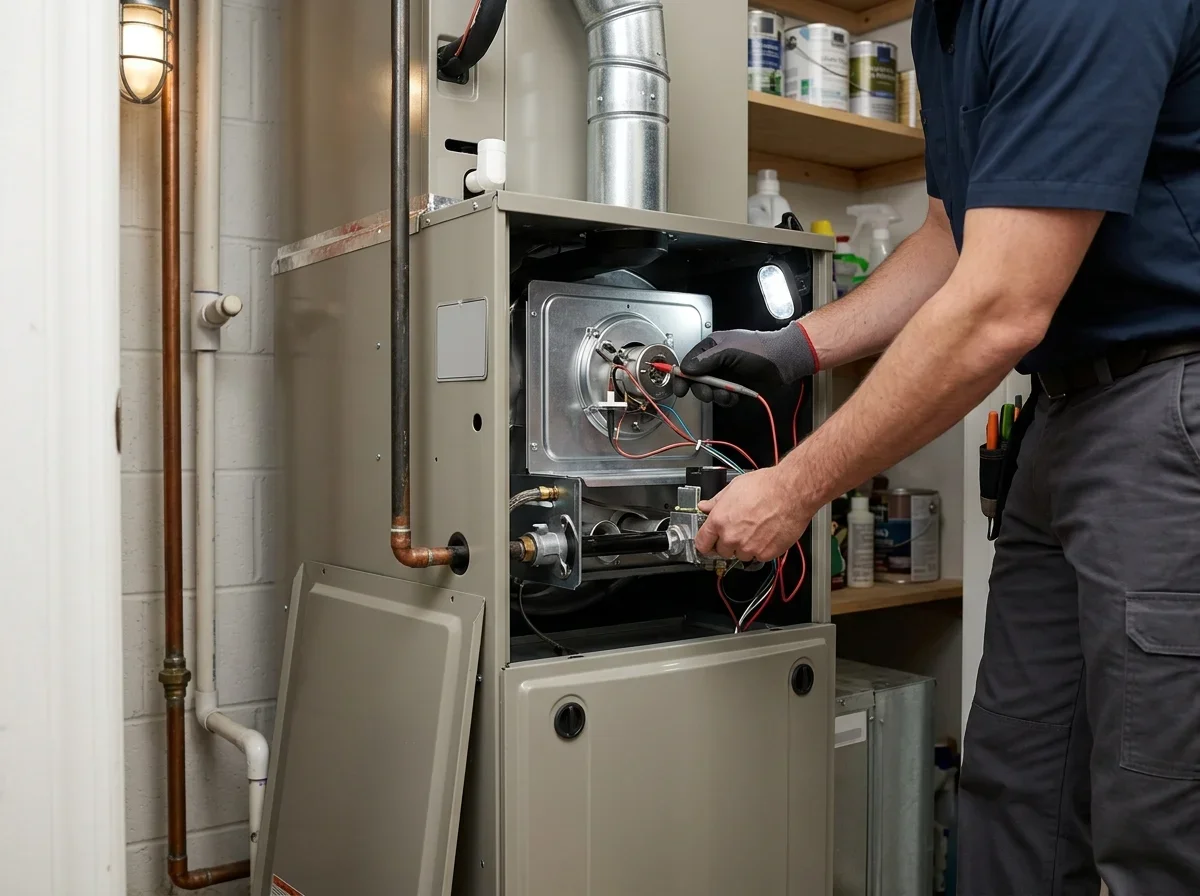
Idle equipment collects dust, and parts that never move can stick. The furnace only reveals all of it when it starts a heating cycle.
Winters here are mild and cold snaps are short, so many households call for repairs on the same few mornings. Expect shops to be busy and call early.
If you want a heating check scheduled before the cold arrives, see how HVAC maintenance plans and warranties handle seasonal visits.
What is the most common problem with a gas furnace?
Ignition and flame-sensing faults are among the most frequent culprits. The furnace control relies on the flame sensor to confirm that burners lit, and if no flame is sensed after the gas valve opens, the furnace shuts down.[2] A dirty sensor or a worn igniter can trigger that shutdown.
A gas furnace typically calls for heat, starts the inducer, proves draft with the pressure switch, lights the igniter, opens the gas valve, confirms flame, and finally starts the blower after a short delay.[3] The step where it quits points to the part.
How it works
A typical gas furnace startup sequence
Step 1: Thermostat calls for heat
Step 2: Inducer starts
Vents gases before ignition
Step 3: Pressure switch proves draft
Step 4: Igniter lights and gas valve opens
Step 5: Flame sensor confirms flame
Step 6: Blower starts after a short delay
| Symptom | Likely failed part | What a tech checks | DIY safe? |
|---|---|---|---|
| Runs but weak or no heat in rooms | Blower motor or capacitor | Airflow, motor and capacitor test | Filter check only |
| Tries to start, then shuts down; noise or no draft | Inducer motor | Inducer operation, vent and draft | Look only; no tools in the vent |
| Inducer runs, but no igniter glow or click | Pressure switch or its tube | Tubing, port, drain, venting and actual draft | Visual check of tubing only |
| Erratic cycling or no response at all | Control board | Blink code, voltage and safety signals | Read and photograph the code |
| Igniter glows, but no flame | Gas valve | Valve voltage, gas pressure, combustion | No. Licensed pros only |
| Flame lights, then dies in seconds | Flame sensor | Sensor condition and flame signal | No. Leave it to a tech |
Furnace not turning on with the thermostat
Start with the simple causes. Confirm the thermostat is set to heat and calling above room temperature, replace weak batteries, and check the breaker.
If all of that checks out and the furnace still shows no sign of life, the control board may be waiting on a safety condition.
Furnace reset button and pilot light
Many Phoenix-metro homes are older, so you may still see a reset button or an older pilot-light setup. Press a reset button once at most. If the unit trips again, something is wrong and repeated resets only mask it.
Blower motor and inducer motor problems
These two motors do different jobs, and mixing them up leads to wrong guesses.
The blower pushes heated air through your ducts. Weak or absent airflow, humming, squealing, or a furnace that fires but never warms the rooms all point here. A failed capacitor can mimic a dead motor, so a tech tests it before condemning the motor.[4]
The inducer runs first and vents combustion gases before ignition. When it is weak or failing, the furnace tries to start, then stops, often with odd noise or no draft.[3]
Costs depend on the model and the job, so ask for an itemized written quote through furnace and heating repair.
Pressure switch, control board and gas valve failures
These three sit in the safety chain, and each is blamed too early.
The pressure switch proves the draft inducer is working before ignition.[3] If the burners never light, the switch may have failed. But a blocked tube, clogged port, or restricted vent can cause the same lockout. Never bypass the switch.
The control board runs the sequence. Erratic cycling or no response can mean a failed board, and the blink code visible through the access window narrows the search. Photograph it before you cycle power.
Pro tip
Photograph the blink code before you cycle power, so the technician can see exactly what the board reported.
The service manuals list the inducer, pressure switch, flame sensor and board as diagnostic points, so a tech should confirm voltage and signals first.[4]
How the parts connect
Parts in the furnace safety chain
Inducer motor
Vents gases before ignition
Pressure switch
Proves draft
Control board
Runs the sequence
Gas valve
Opens after safety signals
Flame sensor
Confirms burners lit
Blower motor
Pushes heated air through ducts
The gas valve opens only after the board receives its safety signals. Manufacturers warn of fire, explosion and carbon monoxide hazards from improper service.[5] This is never a DIY job.
What can you check yourself, and when should you call a pro?
Safe checks take a few minutes and need no tools:
- Set the thermostat to heat, above room temperature, and replace its batteries.
- Check the breaker and the furnace service switch.
- Inspect the filter and replace it if it is clogged.
- Make sure supply and return registers are open and unblocked.
- Watch the sequence and note where it stops. Photograph any blink code.
If you smell gas, do not touch switches. Leave the home and call your gas utility or 911 from outside.
Also call a pro right away for repeated lockouts or burning or rattling noises.
How serious is it
Level 1 of 3: Simple
Signs No heat; thermostat, filter or breaker may be the cause
What to do Do the safe checks, then call a pro if it persists
Level 2 of 3: Urgent
Signs Repeated lockouts, burning or rattling noises
What to do Call a licensed pro right away
Level 3 of 3: Emergency
Signs Smell of gas
What to do Don't touch switches; leave and call the gas utility or 911
Who can legally repair a gas furnace in Arizona?
The Arizona Registrar of Contractors licenses HVAC work under R-39, R-39R and CR-39 classifications, which cover installing, altering and repairing heating systems including gas-fired furnaces.[1] Confirm the license is active, the name matches your contract, and the class covers the work.
A license is generally required when labor and materials exceed $1,000 or a permit is required.[1] The unlicensed handyman exemption never applies when the work connects to natural gas, propane or other fuel supply.
Permits vary by city. Scottsdale requires a Mechanical Permit to repair any furnace. Ask the contractor which permit rule applies in your city and who pulls it.
A license also does not guarantee insurance. Ask for proof of coverage and call the insurer to verify it.
Checklist
Before you hire a furnace repair contractor
0 of 6 ticked
Tick them off as you go. Nothing is saved or sent.
FAQ: Gas furnace repair questions
What is the most common problem with furnaces?
Ignition and flame-sensing faults, along with airflow problems, show up often.
How much does it typically cost to fix a furnace?
Phoenix-area HVAC companies' own websites, checked October 2026, list diagnostic fees that mostly run $70 to $90. One Phoenix company's site says furnace repairs typically run $150 to $1,000.
What is the typical life expectancy of a gas furnace?
Check the manufacturer's documentation for your unit, and ask a licensed tech to assess its condition.
What is the furnace repair-versus-replace rule?
It is a rule of thumb, not a standard. Multiply the repair cost by the furnace's age in years, and if the result is high relative to the price of a new unit, replacement deserves a serious look.
What should I do for emergency furnace repair?
Handle the safe checks first. If you smell gas, leave and call the utility. Otherwise, call a licensed company and ask about after-hours availability.
Why won't my furnace turn on with the thermostat?
Check mode, temperature, batteries, the breaker and the service switch. If those are fine, a tech needs to diagnose.
Can I repair a gas furnace myself?
Stick to thermostat, filter, breaker and visual checks. Gas, ignition, venting and electrical diagnosis belong to a licensed pro.[5]
Questions
- Arizona Registrar of Contractors. "License Classifications." https://roc.az.gov/license-classifications. Accessed October 16, 2026.
- Rheem Manufacturing Company. "Installation Instructions." https://files.rheem.com/LiteratureArchive/708278b.pdf. Accessed October 16, 2026.
- International Comfort Products. "Service and Technical Support Manual." https://www.shareddocs.com/hvac/docs/1011/Public/01/44004441101_ICP_25015.pdf. Accessed October 16, 2026.
- International Comfort Products. "Service and Technical Support Manual." https://www.shareddocs.com/hvac/docs/1011/Public/02/44004441201_ICP_27016.pdf. Accessed October 16, 2026.
- Bosch Thermotechnology. "97% AFUE Condensing Gas Furnace Bosch BGH97 Model." https://resource.gemaire.com/is/content/Watscocom/Gemaire/bosch_97-gas-furnace_en_ii.pdf. Accessed October 16, 2026.