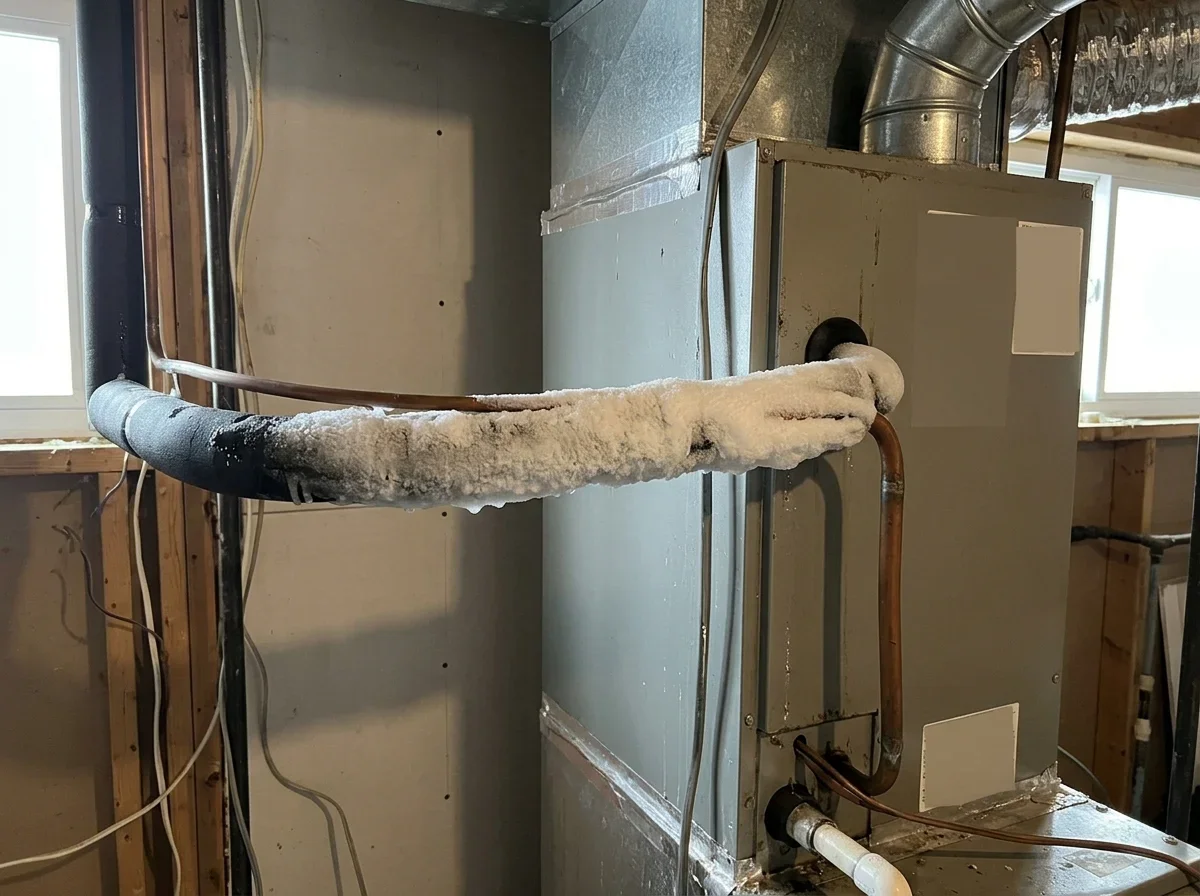
Which fan isn't spinning: the indoor blower or the outdoor condenser fan?
"The AC fan" can mean two machines. The indoor blower pushes house air across the cold coil and out through your vents. The outdoor condenser fan pulls air through the outdoor coil to carry heat out of the refrigerant.
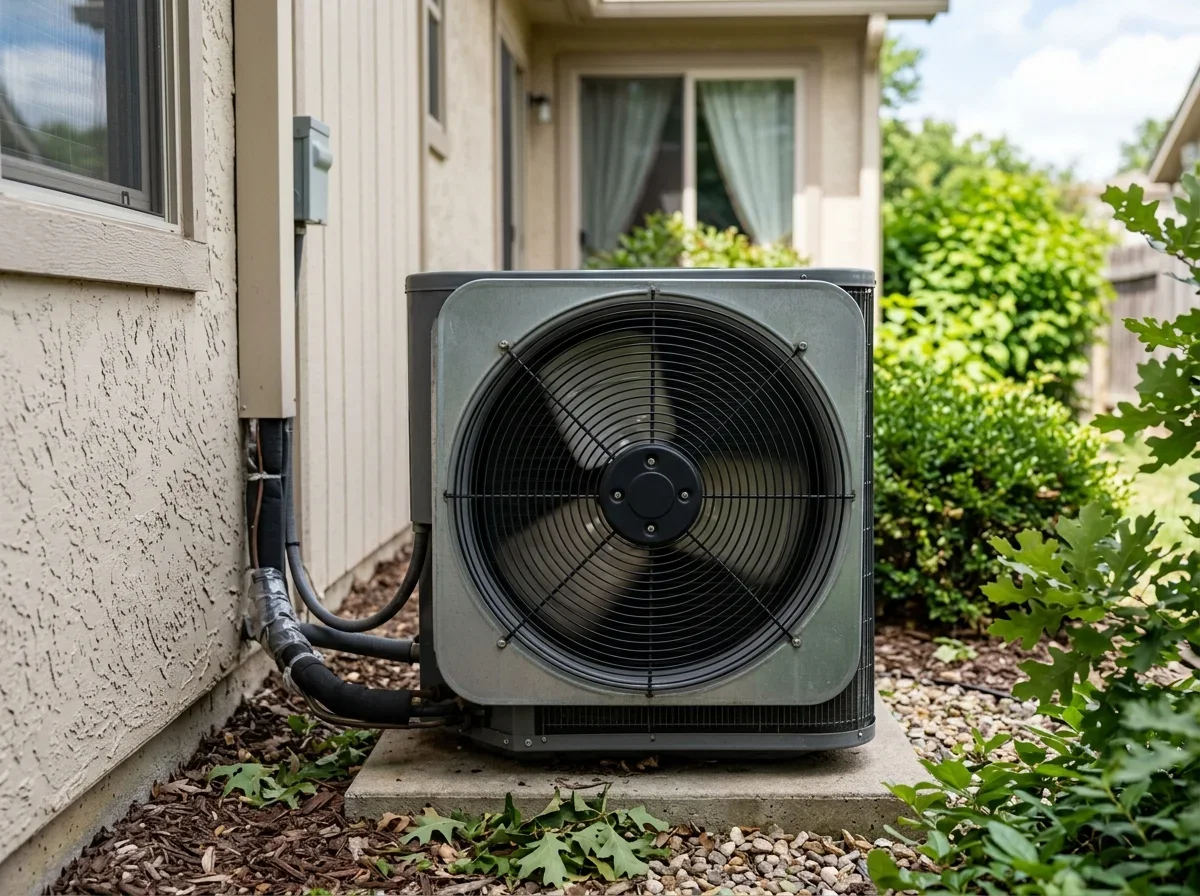
If the vents give little or no air, suspect the blower. If air still comes out but turns warm, and the outdoor unit hums or sits silent with the top fan still, suspect the condenser fan.
How the parts connect
The two fans in your AC system
Indoor blower
Pushes house air across the cold coil and out the vents
Cold indoor coil
Cools the air passing over it
Refrigerant lines
Carry heat between indoor and outdoor units
Outdoor condenser fan
Pulls air through the outdoor coil to carry heat out
Both can stop together if the system loses power.
| Symptom | Likely fan | Common causes | Safe homeowner step | Call a pro? |
|---|---|---|---|---|
| No air from vents, system on | Indoor blower | Power or control problem, failed capacitor, worn motor, safety switch shutoff | Check thermostat, breaker and filter | Yes, if airflow doesn't return |
| Warm air, outdoor unit silent | Outdoor condenser fan | Tripped breaker, contactor, capacitor, motor | Check thermostat and breaker; switch system off | Yes |
| Outdoor unit humming, fan still | Outdoor condenser fan | Capacitor or seized motor | Switch off at thermostat and disconnect; don't touch | Yes, right away |
| Fan spins slowly or noisily | Either | Worn bearings, weak capacitor, debris | Look from a distance; switch off if loud | Yes |
| Nothing runs at all | Both | Breaker, disconnect, thermostat, control board, safety switch | Check thermostat, breaker, disconnect | Yes, if the basics check out |
A dead indoor blower can also lead to a frozen coil, which is covered in why your AC freezes up.
Why is my AC fan not spinning?
Most fan failures come down to a short list: a failed run capacitor, a worn motor or bearings, a tripped breaker or safety switch, a bad contactor, or a control or thermostat problem. Carrier lists a tripped breaker, failed capacitor, burned-out motor and clogged filter among the common causes.[4]
A hum with no spin often points toward a capacitor or a seized motor. Complete silence leans toward power, a switch or controls. Capacitors store electrical energy that helps start fan and compressor motors, so a weak one can leave a healthy motor stuck.[3]
Phoenix adds load. The city logged 113 straight days at or above 100°F in 2024, beating the 76-day record from 1993. Motors and capacitors that run nearly nonstop for months wear faster.
A drain-line safety switch can also shut the system off. If you see water near the indoor unit, read AC leaking water: causes and fixes.
What can I safely check before calling anyone?
Start with the things you can see from a safe distance, without opening anything:
- Set the thermostat to cool, below the room temperature, and replace the batteries if it uses them.
- Confirm the breaker hasn't tripped and the outdoor disconnect is fully seated.
- Check the filter and vents. A clogged filter or blocked airflow can affect the system, so replace a dirty filter. Our guide to filter changes in Phoenix homes covers the schedule.
Don't open panels, reach through the grille or touch wiring.
Checklist
Safe checks before you call
0 of 5 ticked
Tick them off as you go. Nothing is saved or sent.
If those check out, try one reset:
- Turn the system off at the thermostat.
- Wait several minutes.
- Turn it back on once.
If the fan fails again, stop and call.
Should I push-start the fan blade?
No. Some forum answers suggest nudging the blade with a stick or screwdriver. It's a bad idea for three reasons.
First, the blade is a moving hazard, and a fan that was stalled can start without warning. Second, a run capacitor can retain a dangerous charge even after power is disconnected, which is why Carrier says capacitor diagnosis and replacement belong with a qualified HVAC professional.[3]
Third, a blade that spins after a push is a symptom, not a fix. It usually means the capacitor or motor is failing and will stop again.
Pro tip
Switch the system off at both the thermostat and the outdoor disconnect, and never reach into the fan grille. A blade that spins after a push still needs a technician.
Switch the system off at the thermostat and at the outdoor disconnect, then leave diagnosis to a technician. Fan motor and capacitor work is covered under AC coil, fan motor and condenser repair.
Is it okay to run the AC if the fan isn't working?
Not safely. Carrier advises against running the system without proper fan operation.[4] What goes wrong depends on the fan.
With the outdoor fan down, heat stays in the coil and refrigerant, and the unit can trip its safety limits or stress the compressor. Turn the AC off.
If the indoor blower is down, low airflow can ice the coil. Shut it off and see AC freezing up.
While you arrange service, close the blinds, drink water, and move everyone to the coolest room. Our heat wave checklist has more steps.
Key takeaways
- Don't run the AC with a dead fan
- A dead outdoor fan can stress the compressor
- A dead indoor blower can ice the coil
- Turn the system off and arrange service
If it's after hours, call emergency 24-hour AC repair.
What does AC fan motor replacement involve, and what does it cost?
A technician confirms which fan has failed, tests the capacitor and motor, replaces the faulty part, then checks amp draw and airflow. Ask which part failed and ask to see it.
How it works
How a fan repair visit works
Step 1: Confirm which fan has failed
Step 2: Test the capacitor and motor
Step 3: Replace the faulty part
Step 4: Check amp draw and airflow
What drives the cost
Price depends on whether the motor is indoor or outdoor, the motor type (single-speed or variable-speed), and whether the fix is a capacitor alone or a full motor.
For capacitor pricing, see AC capacitor replacement cost and AC repair cost in Phoenix.
Permits and hiring
Repairs and like-for-like swaps often need no permit, but rules differ by city. Phoenix and Mesa generally tie permits to changes in size, capacity or electrical use. Scottsdale requires a mechanical permit for repair or alteration of AC equipment.
Verify the license at the ROC Contractor Search and confirm the class covers the work. Residential HVAC falls under R-39, with CR-39 covering both commercial and residential.[1][2]
Get written terms with the license number, and ask for proof of insurance. More in how to verify an HVAC license.
Frequently asked questions
How do I reset my AC blower fan?
Turn the system off at the thermostat, wait several minutes, and restart it once. If the blower still won't run, check the filter and breaker, then call a pro.
Is it okay to run AC if the fan is not working?
No. A dead outdoor fan can overheat the system, and a dead blower can ice the coil. Turn it off and arrange service.
How to check a fan motor with a multimeter?
Leave this to a technician. Capacitors can hold a charge after power is off, and testing involves live circuits.[3]
What could be the reason why my central air unit isn't turning on?
Start with the thermostat, breaker, outdoor disconnect and filter. Beyond those, causes include a bad capacitor, contactor, control problem or safety-switch shutoff. Our guide to an AC that won't turn on covers those checks.
Why is my outside AC fan not running but the inside is?
The outdoor condenser fan is the likely culprit, often from a capacitor, motor, contactor or power issue. Switch the system off and book a repair.
Why is my AC fan humming but not spinning?
A hum with no spin commonly points to a capacitor problem, though a seized motor is also possible.[4] Switch the system off at the thermostat and disconnect, don't push the blade, and call for AC repair.
Questions
- Arizona Registrar of Contractors. "License Classifications." https://roc.az.gov/license-classifications. Accessed October 16, 2026.
- Arizona Registrar of Contractors. "Arizona Revised Statutes and Rules." https://roc.az.gov/sites/default/files/2024-09/2024%20Statute%20and%20Rules%20Book.pdf. Accessed October 16, 2026.
- Carrier. "What Is an AC Capacitor? Cost, Signs of Failure & Replacement." https://www.carrier.com/us/en/residential/hvac-resources/air-conditioners/ac-capacitor/. Accessed October 16, 2026.
- Carrier. "AC Fan Not Spinning? 8 Causes & How to Fix Them." https://www.carrier.com/us/en/residential/hvac-resources/air-conditioners/ac-fan-not-spinning/. Accessed October 16, 2026.