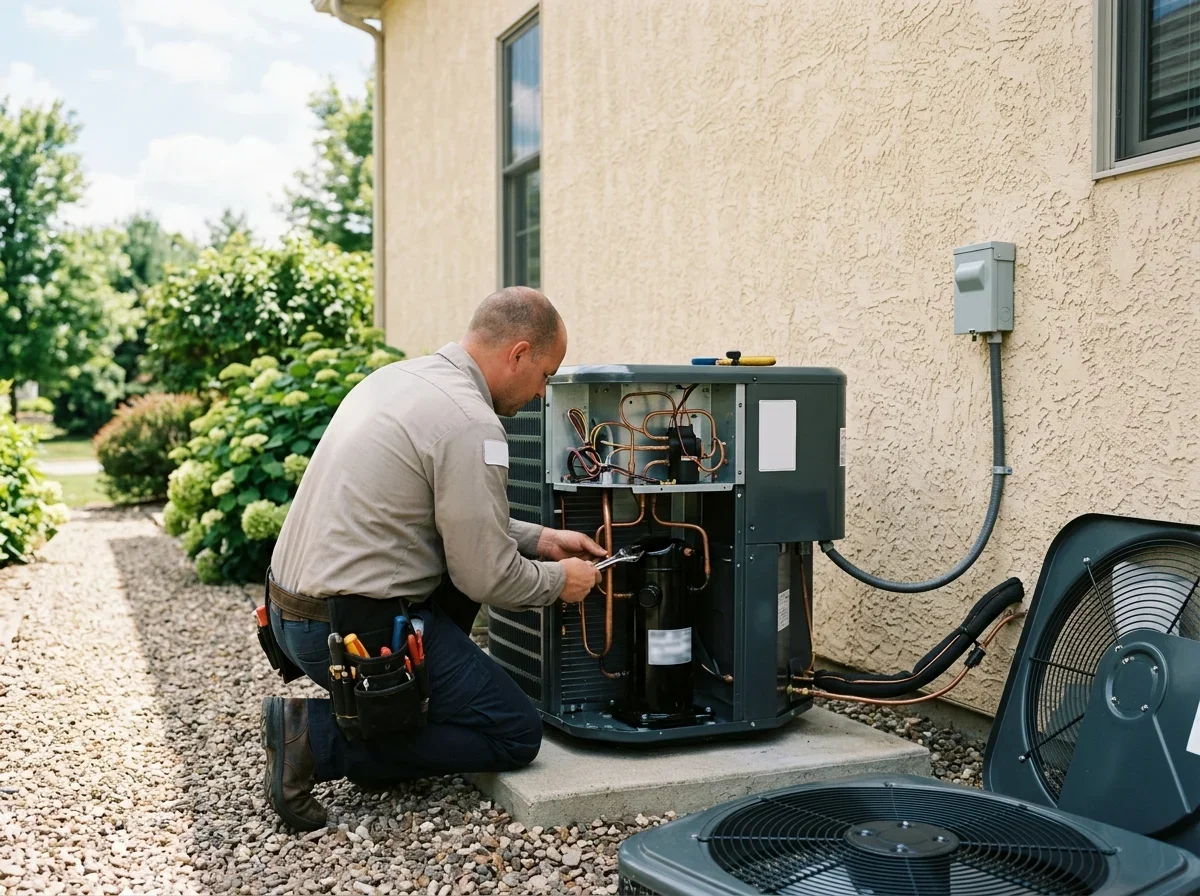
Is the whole AC dead, or just the outdoor unit?
Start by splitting the problem in two, because the checks that follow depend on it. Walk to the thermostat and listen at a vent.
If the thermostat screen is blank and the indoor fan is silent, you have a power or low-voltage problem: batteries, a tripped breaker, or a float switch that has cut power.
If the blower runs but the air is warm and the outdoor unit is silent, the trouble is on the outdoor side. That's where the condenser breaker, disconnect, contactor and capacitor live.
Phoenix summers leave little room for a slow diagnosis. The city logged 113 consecutive days at or above 100°F in 2024, so a July no-start needs a plan, not a shrug.
| Symptom | Likely cause | Safe homeowner check | Call a pro? |
|---|---|---|---|
| Blank thermostat | Dead batteries, tripped breaker or float switch | Replace batteries, check the panel, look at the indoor drain pan | If power stays out after one breaker reset |
| Indoor fan runs, outdoor silent | Condenser breaker, disconnect, contactor or capacitor | Confirm the breaker and outdoor disconnect are on | Yes, if both are on |
| Outdoor hums but fan won't spin | Failed capacitor or stuck motor | Listen from a distance and switch the system off | Yes, right away |
| Breaker trips again after reset | Short, failing motor or compressor | Stop resetting | Yes |
| Clicking, no start | Worn contactor or low control voltage | Check thermostat setting and breaker | Yes |
What should I check first: thermostat and breaker?
Work through these in order. They take minutes and need no tools.
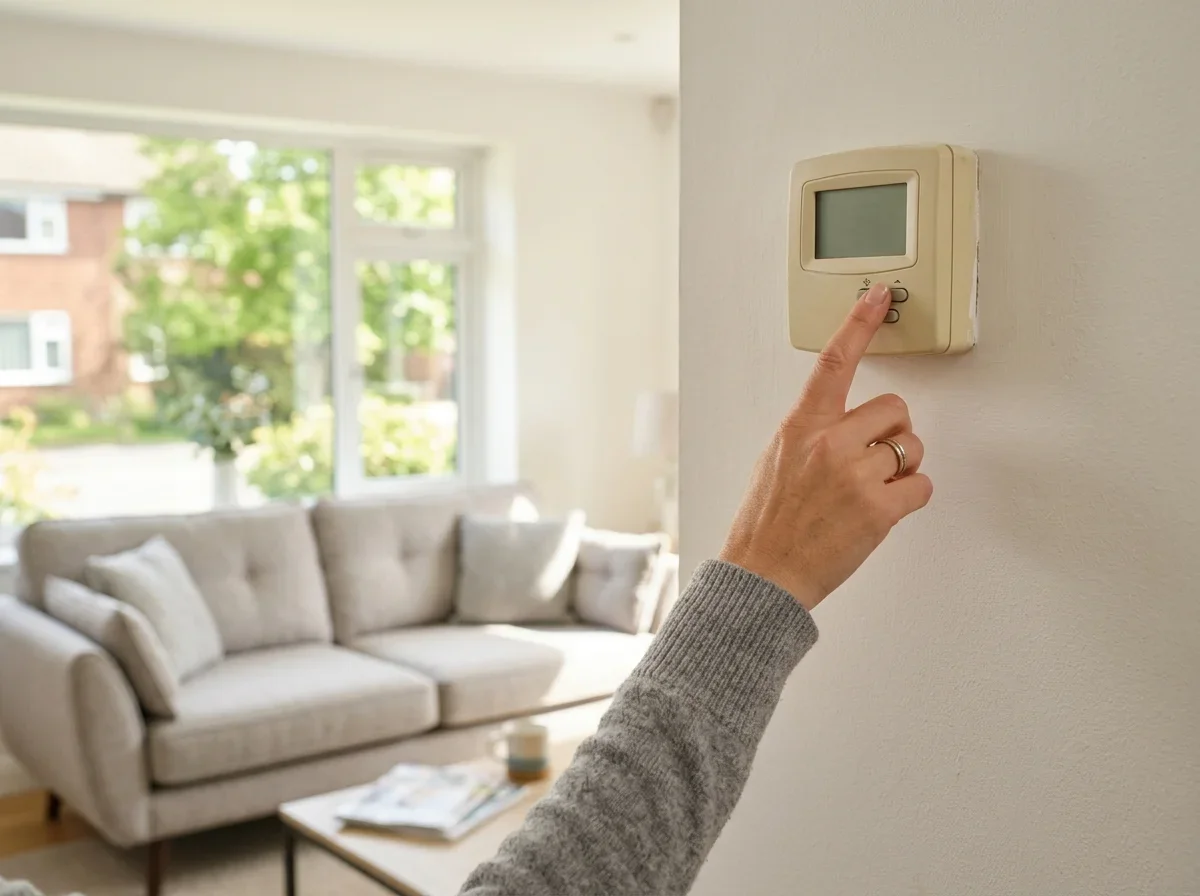
- Set the thermostat to Cool and drop the setpoint several degrees below the room temperature. If the indoor fan starts, the thermostat is calling for cooling.
- Replace the batteries, and make sure a schedule or hold mode isn't overriding your setting.
- Open the breaker panel and find the double-pole breakers for the condenser and the air handler. A tripped breaker can look almost normal, so switch it fully off, then back on.
- Reset once. Only once.
A breaker that trips again points to a short, a seized motor or a grounded compressor, and repeated resets can overheat wiring or damage equipment.
How it works
The first-checks sequence
Step 1: Set thermostat to Cool
Drop the setpoint below room temperature
Step 2: Replace the batteries
Rule out schedule or hold mode
Step 3: Switch the breaker off, then on
Reset once only
Step 4: Look at the indoor drain pan
Standing water may mean a tripped float switch
Carrier lists tripped breakers and thermostat settings among the biggest no-start causes.[5]
Then look at the indoor unit. Many systems have a condensate float switch near the drain pan or in the drain line that cuts power when water backs up. If you see standing water, algae or debris, that may be your answer.
Look, but don't open the panel.
Pro tip
Before you reset anything, note what the thermostat screen and the outdoor unit are doing. A technician can narrow down the cause much faster from that description.
A dirty filter is more likely to cause freezing or weak airflow than a total no-start. Our guide on AC freezing up covers that case.
Why is my outdoor AC unit not turning on?
If the indoor blower runs and the condenser outside stays quiet, check the outdoor disconnect, the box mounted on the wall near the unit. Confirm the pull-out block or switch is fully seated and on.
Don't open the box or handle fuses. Blown disconnect fuses are a pro call when the cause isn't obvious.
Then listen from a safe distance and keep hands clear of the fan. A hum with no fan spin, a click with nothing following, and total silence each point to different parts. Share exactly what you heard with the technician.
Desert sun and heat are hard on exposed insulation, so look at the outdoor conduit and wiring for cracked, chalky or brittle sections. If you see them, stop and call.
Never open the condenser panel without cutting power at both the disconnect and the breaker, and even then, don't. Capacitors can hold a charge after power is off, which is why manufacturers direct electrical work to qualified technicians.[4]
Could it be the capacitor or contactor?
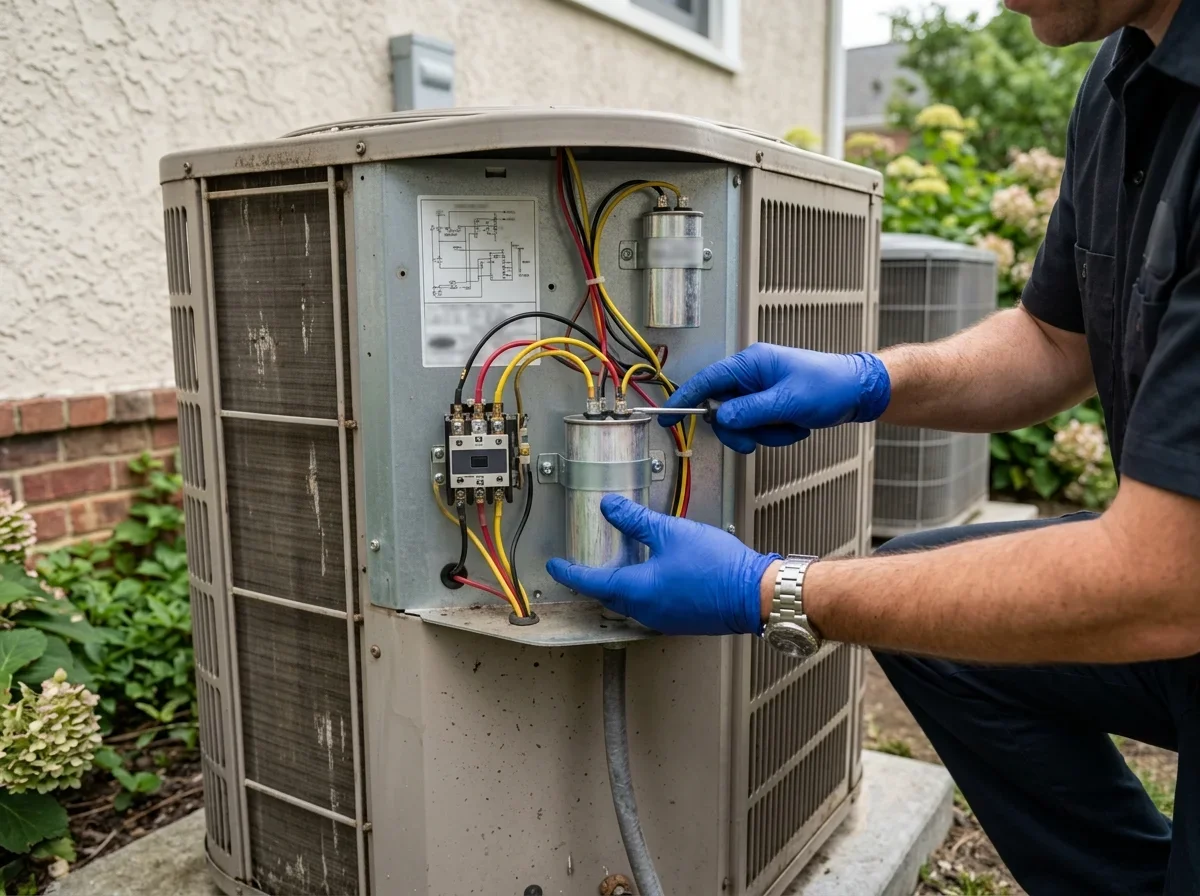
Once power checks out, these two parts are the usual suspects. Carrier identifies the capacitor and contactor among the electrical components tied to no-start symptoms, humming and breaker trips.[4]
The capacitor stores the charge that kicks the compressor and fan motor into motion. A failing one often shows up as humming, a fan that only spins after a push, or a bulged top.
The contactor is the switch that closes to send power to the compressor. Pitted or stuck contacts can mean no start, or a unit that won't shut off.[5]
How the parts connect
Where power travels on the outdoor side
Breaker
At the panel
Outdoor disconnect
Box on the wall near the unit
Contactor
Switch that sends power to the compressor
Capacitor
Stores the charge to start motors
Compressor and fan motor
Stop here. Everything beyond this point is technician work.
For capacitor and compressor jobs, see AC compressor and capacitor replacement, or start with AC repair for diagnosis. For pricing, the capacitor replacement cost guide breaks down what drives the bill.
Contactor replacement: DIY or pro?
Searching "AC contactor replacement" turns up plenty of how-to videos. Most homeowners shouldn't follow them.
The work happens inside live 240V equipment. Some online advice, like pushing the contactor in with a screwdriver, invites arc and shock injuries.
A pro tests incoming voltage and checks the capacitor too, so the real cause gets fixed. Replacing a contactor because the symptoms match can leave a failing capacitor behind.
What if the compressor won't start?
Signs of a failing compressor include a breaker that keeps tripping, a hum followed by shutoff, or an outdoor fan that runs while the house never cools. Those are also the signs of a bad capacitor or contactor, so a pro should test those parts first.
Refrigerant-circuit problems are pro-only work, and technicians who handle refrigerants need EPA Section 608 certification. Ask to see it. Our guide to HVAC credentials explains what that and NATE mean.
If the compressor is confirmed dead, repair versus replace comes down to the unit's age and warranty.
See the compressor replacement cost guide and our repair or replace comparison.
When should I call a licensed pro in Phoenix?
Call for any of these:
- A breaker that trips again after one reset
- A burning smell or visibly burned wires
- Blown disconnect fuses
- Any need to open the condenser
Hire an ROC-licensed contractor holding an R-39, R-39R or CR-39 classification, which covers air-conditioning repair.[1] The surest way to verify a license is the ROC Contractor Search at roc.az.gov, which searches by company name, person or six-digit license number.[2]
Our license verification guide walks through it. Also ask for proof of insurance, since a license alone doesn't guarantee coverage.
Key takeaways
- Check the thermostat, batteries and breaker first, and reset the breaker only once
- Never open the condenser panel; capacitors can hold a charge
- Capacitor and contactor faults are the usual outdoor-side culprits
- Hire an ROC-licensed contractor with an R-39, R-39R or CR-39 classification
Permits depend on the city, so ask your contractor.
If a senior, infant or pet is in the house, or indoor temperatures are climbing with no quick fix, don't wait. The National Weather Service advises staying indoors when possible, watching high-risk people, and moving anyone with heat-illness symptoms to a cool place.[3]
Use emergency 24-hour AC repair, and see what to do in a heat wave.
FAQ
Why is my AC unit not kicking on outside?
Check that the breaker and outdoor disconnect are on, then listen. Silence, a hum or clicking each point to the disconnect, capacitor or contactor.
If power checks out, call a pro through AC repair.
Can a bad thermostat cause AC issues?
Yes. Dead batteries, the wrong mode or a hold setting can keep the system from starting. Set it to Cool, lower the setpoint, and see whether the indoor fan responds.
What are signs of a failing AC compressor?
Look for repeated breaker trips, a hum then shutoff, or an outdoor fan running with no cooling. A failed capacitor or contactor can mimic these, so have them tested first. See compressor costs.
Why does my AC keep tripping the breaker?
Overload, a short, or a failing capacitor, motor or compressor can all cause it. Reset once, and if it trips again, stop and call a licensed pro.
Can I replace an AC plug myself?
Most central AC has no plug. It's hardwired through an outdoor disconnect.
How long should an AC unit last?
It varies with maintenance, climate and equipment. Phoenix systems run hard, so regular service matters, and a tune-up helps catch weak parts before the first heat wave.
Questions
- Arizona Registrar of Contractors. "License Classifications." https://roc.az.gov/license-classifications. Accessed October 16, 2026.
- Arizona Registrar of Contractors. "Arizona Registrar of Contractors Contractor License Guide." https://roc.az.gov/sites/default/files/2022-07/20201221-Guide.pdf. Accessed October 16, 2026.
- National Weather Service, Phoenix. "NWS Phoenix Heat Page." https://www.weather.gov/psr/heat. Accessed October 16, 2026.
- Carrier. "AC Parts Guide: What to Know About AC Parts." https://www.carrier.com/us/en/residential/hvac-resources/air-conditioners/ac-parts/. Accessed October 16, 2026.
- Carrier. "AC Unit Not Turning On? Troubleshooting Steps & Solutions." https://www.carrier.com/us/en/residential/hvac-resources/air-conditioners/ac-unit-not-turning-on/. Accessed October 16, 2026.