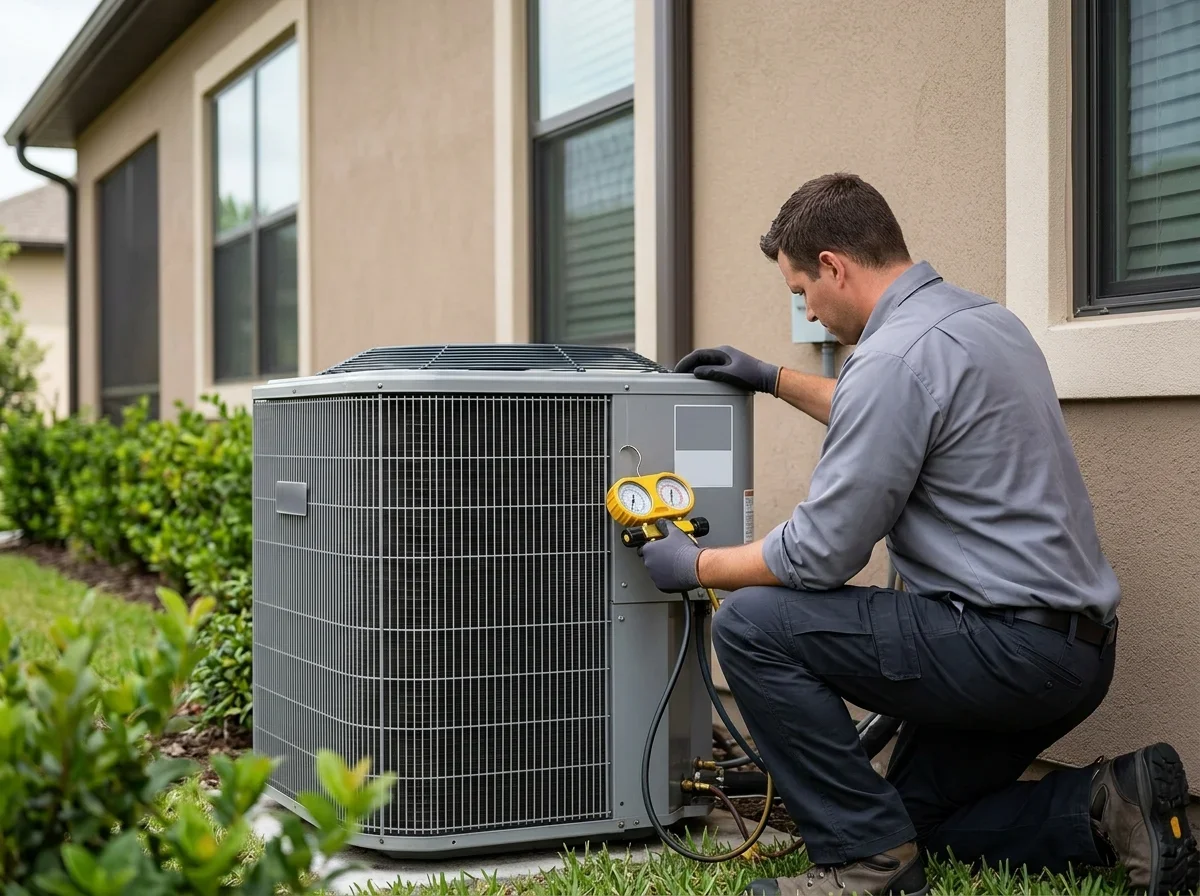
What is R-454B refrigerant?
R-454B is a newer refrigerant for residential air conditioners and heat pumps, designed to replace R-410A. EPA identifies it as a blend of 68.9% HFC-32 and 31.1% HFO-1234yf.[2]
It belongs to the A2L safety class, meaning mildly flammable with low toxicity. Technicians do need training and the right equipment for recovery, charging, and leak checks.
The reason for the switch is global warming potential.
EPA's listing shows R-454B at 465, compared with 2,088 for R-410A.[2] That gap ties into the AIM Act, which phases down HFC production and consumption by 85% from historic baseline levels by 2036.[1]
R-22, R-410A and R-454B: which one does your AC use?
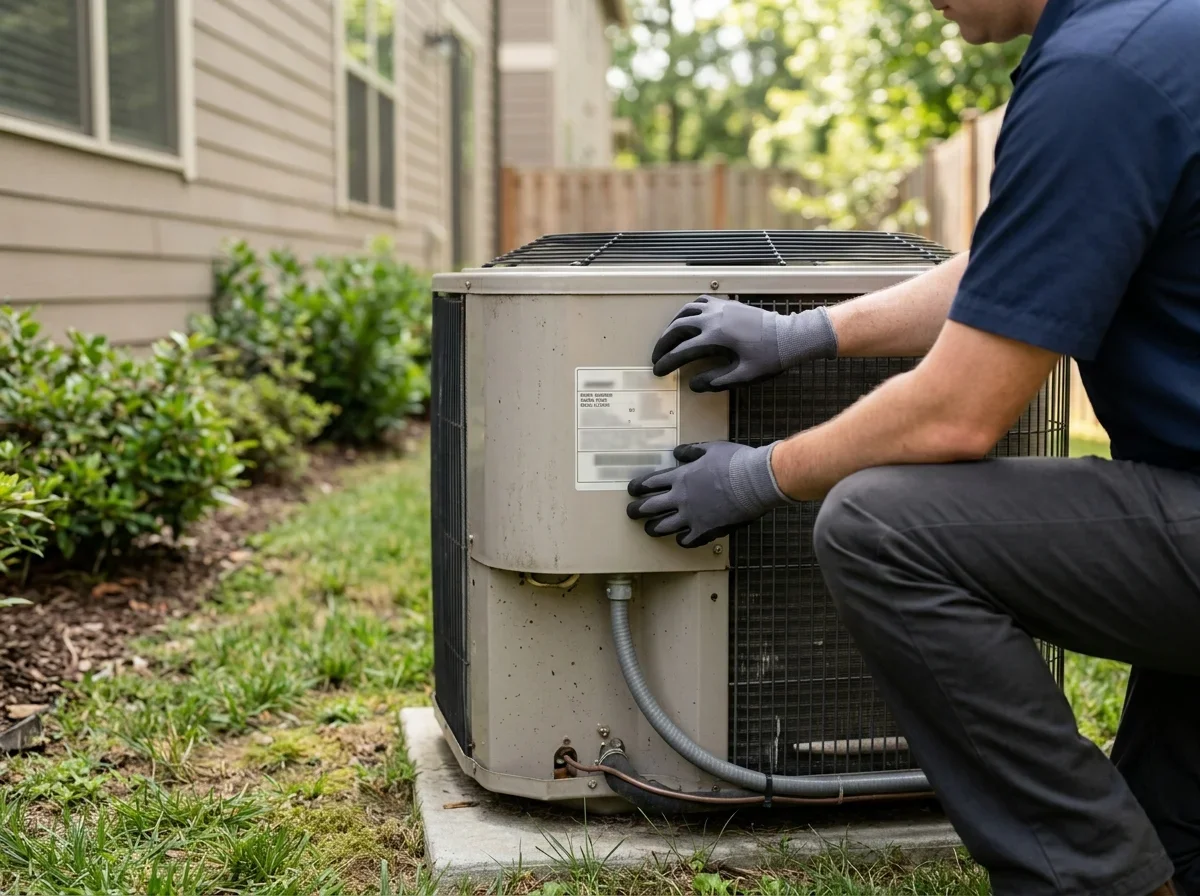
Read the nameplate on the outdoor condenser. It lists the refrigerant type and factory charge, and you need no tools.
- Find the data label on the side of the outdoor unit.
- Look for "Refrigerant" or "Refrigerant type" (R-22, R-410A, or R-454B).
- Photograph the model number, serial number, and factory charge.
As a general guide, older systems tend to use R-22, mid-age systems R-410A, and the newest equipment R-454B. Age alone doesn't settle it. Trust the label rather than a salesperson's shorthand.
EPA says R-410A components can still be sold to service existing systems, but cannot be used to install a new R-410A system beginning January 1, 2026.[1] Check the same EPA page for the R-22 production end.
| Typical systems | New equipment | Servicing | Relative refrigerant cost | What it means for a repair | |
|---|---|---|---|---|---|
| R-22 | Oldest systems | Not an option | Supply is limited; confirm status with EPA | Generally the priciest of the three | A major leak often points toward replacement |
| R-410A | Mid-age systems | Cannot be used to install a new system from January 1, 2026[1] | Components can still be sold for existing systems[1] | Supply is shifting as the phasedown continues | Often still repairable if the leak is small |
| R-454B | New systems | The current platform | Needs A2L-trained service | Newer and varies by supplier | Ask about manufacturer procedures and warranty |
Cost direction in the table is general. Ask your contractor for the current refrigerant line item on an itemized quote.
R-454B vs. R-32: what is the difference?
Both are A2L refrigerants. R-32 is a single-component refrigerant, while R-454B is a blend that includes R-32 and R-1234yf.[2]
Side by side
R-32 versus R-454B
R-32
- A2L refrigerant
- Single-component refrigerant
R-454B
- A2L refrigerant
- Blend that includes R-32 and R-1234yf
Equipment is designed for one refrigerant only. You cannot put R-454B in an existing R-410A system, and you cannot mix refrigerants to stretch a charge. Moving to R-454B means new equipment, not a swap.
Charging by pressure alone, without proper recovery, evacuation, and weighing in the charge, is a poor DIY project. That goes double for an A2L product.
What does it cost to recharge or replace refrigerant?
Your bill reflects refrigerant type, system size, where the leak is, and whether the leak is repaired first. Leak testing, recovery, labor, and parts all show up on the invoice.
Phoenix-area HVAC companies' own websites, checked October 2026, most often list diagnostic or service-call fees of $89 to $99. One Phoenix company's site says refrigerant-related work typically runs $400 to $1,200+. That is general guidance, not a quote.
Topping off a leaking system is a stopgap. Ask for a documented leak search and a written plan, and see AC Refrigerant Recharge and Leak Repair for how diagnosis works.
Pro tip
Ask for the refrigerant line item and the leak repair on separate lines of the quote, so you can see what you are paying to top off and what you are paying to fix.
For what recharging involves, read AC Recharge Kits vs. a Pro Recharge.
Repair the old system or buy a new one in Phoenix?
Phoenix logged 113 straight days at or above 100°F in 2024, breaking a record set in 1993. A leaking unit that needs repeated top-offs is a weak bet.
- R-22 with a major leak: replacement is the stronger candidate, since EPA ended R-22 production and supply is limited.
- R-410A with a small, findable leak: still serviceable, because EPA says components can be sold to service existing systems.[1]
- Failed coil or repeated losses: compare a verified repair against replacement cost and remaining system life.
- Already on R-454B: ask about A2L-trained service and your warranty before authorizing work.
Get two written opinions if a contractor recommends replacement only because the refrigerant is older. See Repair or Replace Your AC? How to Decide in Phoenix and the AC replacement cost guide.
Permits differ by city
Phoenix states that replacing or altering a refrigeration system to use a different class of refrigerant requires a permit and compliance with the code requirements for the new refrigerant.[4]
| City | Like-for-like replacement |
|---|---|
| Phoenix | No permit unless size, capacity, or location grows |
| Mesa | No permit if electricity use is the same or less |
| Scottsdale | Minimum Mechanical Permit required |
| Unincorporated Maricopa County | Like-for-like can be web-issued; roof-mounted units get technical review |
Ask which rule applies in your city and who pulls the permit. Our guide on AC replacement permits in the Phoenix area goes deeper.
Who can work on R-454B systems in Arizona?
The Arizona Registrar of Contractors licenses HVAC contractors. The R-39 Air Conditioning and Refrigeration classification covers installation and repair of comfort air-conditioning, refrigeration, evaporative cooling, ventilation, and heating equipment.[3]
Handling refrigerant also requires EPA Section 608 certification. See NATE, EPA 608 and NADCA: What HVAC Credentials Mean.
Before you sign:
- Look up the license in ROC Contractor Search at roc.az.gov and confirm it is active.
- Check that the company name matches your contract and the class covers the job.
- Ask whether the technician is trained for A2L refrigerants.
- Request proof of insurance, since a license does not guarantee it.
Our guide on verifying an HVAC contractor's license in Arizona walks through each step.
R-454B refrigerant FAQ
What are the key differences between R-32 and R-454B refrigerants?
Both are A2L, but R-32 is a single-component refrigerant and R-454B is a blend that includes R-32 and R-1234yf. Neither can be swapped into equipment built for the other.
What refrigerant is used in an AC system?
Older systems use R-22, mid-age systems R-410A, and new equipment R-454B. Read the outdoor unit's nameplate to confirm yours.
What is the current price of R-454B refrigerant in the USA?
Prices vary by supplier and change often, so check dated supplier listings. A homeowner's bill depends more on labor, leak diagnosis, and repair than on cylinder price.
How much does it cost to replace refrigerant in an AC unit?
It depends on refrigerant type, system size, and leak location. One Phoenix company's site lists refrigerant-related work at $400 to $1,200+, as general guidance. Get an itemized written quote.
Can R-454B be used in an older R-410A system?
No. Equipment is designed for one refrigerant, so an R-410A system needs R-410A, and R-454B means new equipment.
Is R-454B safe in a home?
It is classed A2L, mildly flammable with low toxicity, and is used in new residential equipment. Hire a qualified pro through AC Refrigerant Recharge and Leak Repair.
Questions
- U.S. Environmental Protection Agency. "Frequent Questions on the Phasedown of Hydrofluorocarbons." https://www.epa.gov/hfcs/frequent-questions-phasedown-hydrofluorocarbons. Accessed October 16, 2026.
- U.S. Environmental Protection Agency. "Kings International Group Inc. – Finding of Violation." https://www.epa.gov/system/files/documents/2026-04/caa-and-aim-act-cover-letter-and-fov-kings-international-group-inc.pdf. Accessed October 16, 2026.
- Arizona Registrar of Contractors. "License Classifications." https://roc.az.gov/license-classifications. Accessed October 16, 2026.
- City of Phoenix Planning and Development Department. "Work Exempt from Permit." https://www.phoenix.gov/content/dam/phoenix/pddsite/documents/trt/external/dsd_trt_pdf_00618.pdf. Accessed October 16, 2026.