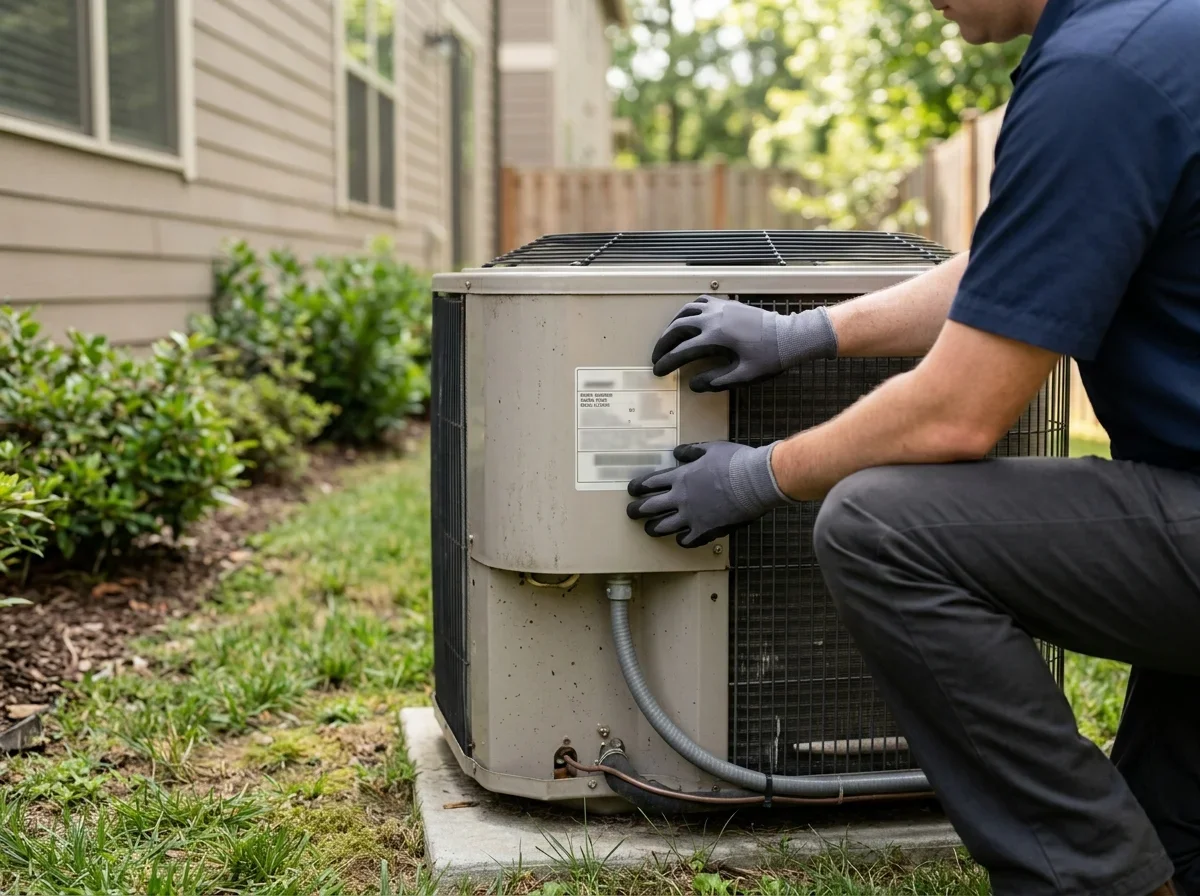
Can you recharge your house AC with a kit?
No. Consumer cans are made for cars, and a home central AC that needs refrigerant has a leak.
The fix is finding and repairing the leak, then charging the system to spec.
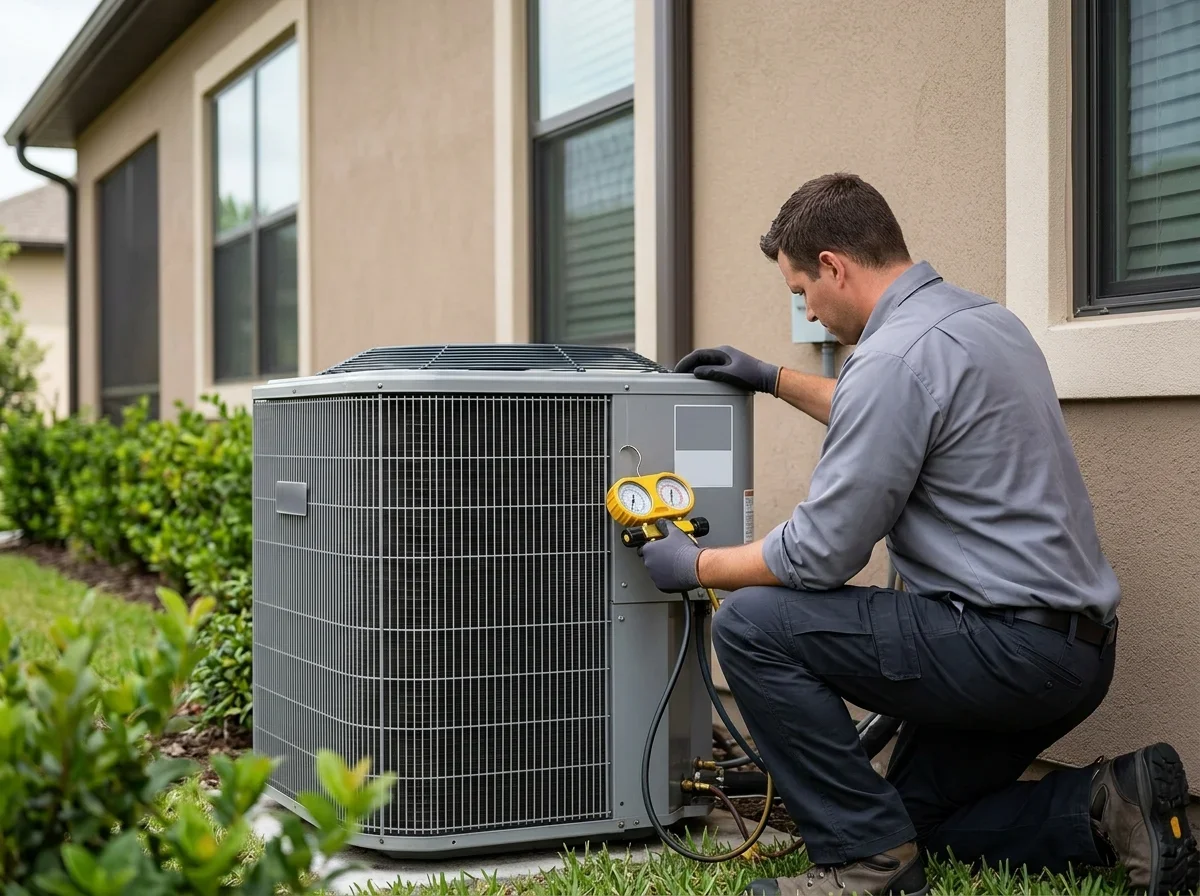
The EPA's guidance to homeowners is to have a technician locate and repair AC refrigerant leaks rather than simply "topping off" the system, and to use technicians certified under Section 608.[1] That certification is required for anyone doing maintenance, service, or repair that could reasonably be expected to release refrigerant.[2]
Our guide to NATE, EPA 608 and NADCA credentials explains how it compares with other badges.
A can also cannot weigh in the exact charge your system specifies. That figure is printed on the unit nameplate, and a technician adds it by weight after the system has been evacuated.
Before anyone reaches for a can, run through the warm air symptom checklist. A dirty filter, a failed capacitor, or a frozen coil can mimic a refrigerant problem.
Why low refrigerant means you have a leak
Refrigerant is not fuel. It circulates in a sealed loop, absorbing heat inside and releasing it outside, and it is never "used up."
If the charge is low, it went somewhere.
That is why topping off backfires. The new refrigerant escapes through the same hole, and the cooling problem comes back. EPA technician materials say equipment should be leak-tested before charging or recharging, and its requirements call for leak verification before and after adding refrigerant in applicable systems.[3][4]
How the parts connect
The sealed refrigerant loop
Indoor coil
Absorbs heat from the house
Compressor
Circulates the refrigerant
Outdoor coil
Releases heat outside
Metering device
Controls refrigerant flow
The stop-leak problem
Many car kits bundle a sealant. In a home system, sealant is a gamble.
It can plug small coil passages or metering devices. It can also contaminate the recovery equipment a technician uses later. Skip it unless a licensed pro specifically recommends it for your equipment.
Why Phoenix raises the stakes
Phoenix logged 113 consecutive days at or above 100°F in 2024, beating the 76-day record from 1993. A slow leak can limp along in spring, then give out under months of continuous load.
Book a leak check in spring, ahead of the May-June rush, rather than waiting for a July breakdown.
What a car AC recharge kit is, and why it does not fit a home system
A typical kit holds a can of refrigerant (usually R-134a, with newer vehicles using R-1234yf), a short hose, and a low-side pressure gauge. Some add a stop-leak additive.
Home systems are a different machine. They use different refrigerants, different fittings, and a charge that is specified by weight.
Confirm what your unit uses from its nameplate, and see R-454B refrigerant explained for what newer residential equipment looks like.
The risks of mismatched DIY are real. Overcharging stresses the compressor, the wrong refrigerant can ruin performance, and air or moisture introduced during connection creates new repair problems.
If you really mean your car
The usual routine is to find the low-pressure port, read the gauge with the engine running, and add refrigerant in short bursts while watching the reading.
A kit can restore some cooling when the loss is slow, but it does not repair the leak there either.
What does a pro recharge involve, and what does it cost?
A proper job follows a sequence. The technician finds the leak, repairs it, evacuates the system with a vacuum pump, and then charges by weight to the manufacturer's specification.
How it works
How a professional recharge works
Step 1: Find the leak
Leak test before any refrigerant is added
Step 2: Repair the leak
Step 3: Evacuate with a vacuum pump
Step 4: Charge by weight to specification
The full process is laid out on our AC refrigerant recharge and leak repair page.
Cost depends on a handful of factors, and quotes vary:
- Where the leak is (an exposed fitting is a different job than a coil buried in the air handler)
- Which refrigerant your system uses
- System size and how much charge it holds
- Labor and diagnostic time
That is why a pro visit costs more than a can. For broader numbers, see AC repair cost in Phoenix.
Sometimes the leak is in the evaporator coil, or it keeps coming back. Then repair cost can approach replacement cost. Our repair or replace guide walks through it.
| DIY kit | Licensed pro recharge | |
|---|---|---|
| Built for | Vehicle AC systems | Residential central AC and heat pumps |
| Finds the leak? | No, may add sealant instead | Yes, leak testing and repair come first |
| Refrigerant handling and certification | No certification; consumer can and hose | Section 608 certified technician with recovery and vacuum equipment |
| Charge accuracy | Pressure gauge estimate | Weighed in to the nameplate specification |
| Risk | Overcharge, wrong refrigerant, contamination | Lower, with documented testing |
| Typical cost drivers | Kit and refrigerant purchase | Leak location, refrigerant type, system size, labor |
How to hire a licensed recharge and leak repair contractor in Phoenix
Arizona requires an active license from the Arizona Registrar of Contractors (ROC) for this work. The R-39 classification covers installation and repair of comfort air-conditioning systems.[6]
Work through this list before you sign anything:
- Look up the license at roc.az.gov/before-hire and confirm it is active and belongs to the company name on the contract. Our license verification guide shows how.
- Check the class. It should be R-39, R-39R, or CR-39 for residential work.
- Ask for proof of insurance. The ROC requires workers' compensation but no other insurance for licensure, so a license does not guarantee liability coverage. Request certificates and call the insurer.
- Ask about EPA Section 608 certification for the technician who will handle refrigerant.
- Get a written contract with the license number, start and completion dates, and checks payable to the company named on it.
- Ask about permits. Rules differ across Phoenix, Mesa, Scottsdale, and unincorporated Maricopa County. Ask which one applies to your job, or check with your city's permit desk.
For more screening questions, see questions to ask before hiring a Phoenix HVAC contractor.
Pro tip
Ask for the leak location, the repair plan, and a documented post-repair test in writing before any refrigerant is added.
Frequently asked questions
Can you recharge your house AC?
Not with a consumer kit. Home systems are sealed, regulated, and charged by weight, and low refrigerant means a leak that needs repair first.[1]
A licensed contractor handles it through AC refrigerant recharge and leak repair.
What is the best AC recharge kit?
For a house, none. For a car, choose a kit that matches your vehicle's refrigerant type, which is listed under the hood or in the owner's manual.
How to use an R-134a recharge kit?
This is car-only. Locate the low-pressure port, connect the hose, read the gauge with the AC running, and add refrigerant in short bursts without overfilling.
Can you recharge car air con yourself?
Many drivers do, and a kit can restore some cooling if the loss is slow. It still does not fix the leak.
Why does my AC need refrigerant if it is a closed system?
It should not. A closed loop does not consume refrigerant, so a low charge points to a leak somewhere in the coils, lines, or fittings.[1]
How much does an AC recharge cost?
It depends on leak location, refrigerant type, system size, and labor, and quotes vary.
Ask for the leak location, the repair plan, and a documented post-repair test in writing.
Questions
- U.S. Environmental Protection Agency. "Homeowners and Consumers: Frequently Asked Questions." https://www.epa.gov/ods-phaseout/homeowners-and-consumers-frequently-asked-questions. Accessed October 16, 2026.
- U.S. Environmental Protection Agency. "Questions and Answers for Section 608 Certified Technicians." https://www.epa.gov/section608/epas-refrigerant-management-program-questions-and-answers-section-608-certified. Accessed October 16, 2026.
- U.S. Environmental Protection Agency. "Type 2 (high-Pressure)." https://www.epa.gov/section608/test-topics. Accessed October 16, 2026.
- U.S. Environmental Protection Agency. "EPA’s Refrigerant Management Requirements — What Technicians Need to Know." https://www.epa.gov/sites/default/files/2016-09/documents/608_fact_sheet_technicians_0.pdf. Accessed October 16, 2026.
- U.S. Environmental Protection Agency. "Section 608 of the Clean Air Act: Stationary Refrigeration and Air Conditioning." https://www.epa.gov/sites/default/files/2018-09/documents/section_608_of_the_clean_air_act.pdf. Accessed October 16, 2026.
- Arizona Registrar of Contractors. "License Classifications." https://roc.az.gov/license-classifications. Accessed October 16, 2026.